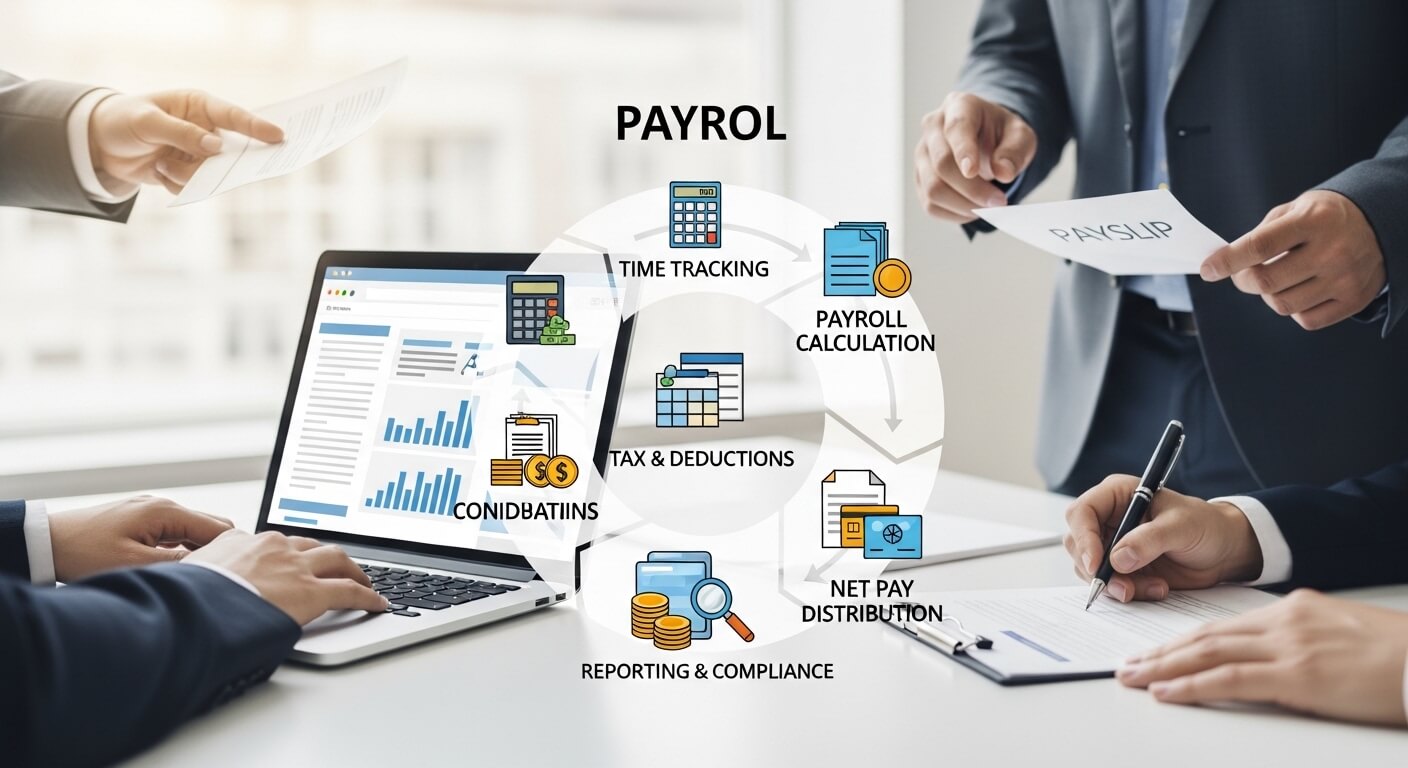
Introduction to Payroll Process
The payroll process is a critical function in any business, ensuring employees are paid accurately and on time. In the UK, maintaining a smooth payroll system is essential for compliance with HMRC regulations.
Accurate payroll helps avoid penalties and keeps employee trust intact. Integrating payroll with accounting and payroll systems ensures financial records are reliable.
A strong payroll department plays a vital role in managing wages, deductions, and statutory payments. This includes payroll administration, payroll bookkeeping, and ensuring correct payroll payable amounts.
Businesses of all sizes, from startups to large corporations, need a well-defined payroll setup and structured workflow. This includes understanding payroll methods, statutory obligations, and technology-driven solutions for efficiency.
Understanding Payroll in the UK
In the UK, the payroll process is more than just paying salaries. It involves calculating taxes, managing employee benefits, and reporting to HMRC. Companies must follow strict guidelines to maintain compliance.
Payroll in UK businesses is affected by tax codes, national insurance contributions, and pension schemes. Small and large companies alike rely on payroll services to manage these complexities.
A proper payroll structure includes categorizing employees, defining salary grades, and implementing deductions. The payroll department ensures these processes run smoothly.
Payroll setup for UK companies involves registering with HMRC, setting up PAYE (Pay As You Earn), and selecting appropriate payroll methods.
Modern payroll administration often uses cloud-based tools to simplify management, reduce errors, and integrate with accounting and payroll systems.
Benefits of a good payroll system include:
- Accurate employee payments
- Compliance with tax laws
- Efficient record keeping
- Integration with accounting systems
Components of Payroll Process
Understanding the components of the payroll process is essential for smooth operations. Key elements include:
1. Employee Information
- Full name, address, and National Insurance number
- Salary or hourly rate
- Tax code
- Benefits such as health insurance or pension contributions
2. Deductions
- Income tax according to HMRC guidelines
- National Insurance contributions
- Pension contributions
- Student loan repayments, if applicable
3. Bonuses and Commissions
- Must be recorded accurately in the payroll structure
- Affects final payroll payable amount
- Requires additional reporting for taxation
4. Payroll Methods
- Direct deposit: Fast and secure
- Cheque payments: Still used by some small businesses
- Cash payments: Rare but applicable for small setups
- Online payroll services: Cloud-based solutions that streamline the payroll processing process
The payroll department ensures these components are correctly processed and recorded, maintaining payroll bookkeeping accuracy.
Payroll Department and Its Role
The payroll department is responsible for managing all payroll-related activities. Their responsibilities include:
- Managing employee records
- Calculating salaries, deductions, and bonuses
- Handling payroll payable amounts
- Ensuring compliance with HMRC
Key tasks of payroll administration include:
- Verifying employee data
- Processing payroll accurately
- Maintaining payroll records
- Reporting to accounting teams
A competent payroll team integrates seamlessly with accounting and payroll workflows, ensuring financial statements reflect correct employee expenses.
The payroll department also liaises with external professionals like chartered accountant Berkshire or small business accountant for compliance and tax planning.
Payroll Setup and Payroll Structure
A proper payroll setup lays the foundation for a smooth payroll process. Steps include:
- Registering the company with HMRC
- Setting up PAYE for employees
- Defining the payroll structure, including basic salary, overtime, and deductions
- Selecting payroll methods suitable for employees
Payroll structure ensures clarity in salary distribution and deductions. Common elements include:
- Basic salary
- Overtime pay
- Bonuses and commissions
- Tax and National Insurance deductions
Integrating payroll administration with payroll bookkeeping ensures all payroll records are accurate and ready for audits. Businesses may also rely on online tax accountants for smooth processing.
Payroll Processing Process Explained
The payroll processing process is the core of any payroll department. It ensures employees are paid accurately and on time.
Step 1: Collecting Employee Data
- Gather personal information, tax codes, and employment contracts.
- Record details of overtime, bonuses, and commissions.
- Ensure data is updated in the payroll system.
Step 2: Calculating Wages
- Use the payroll structure to calculate salaries.
- Deduct taxes, National Insurance, and other contributions.
- Factor in any bonuses, commissions, or reimbursements.
Step 3: Applying Deductions
- Statutory deductions: PAYE, NI, pensions.
- Optional deductions: union fees, loans, or charitable contributions.
- Calculate final payroll payable amounts accurately.
Step 4: Processing Payments
- Choose appropriate payroll methods: direct deposit, cheque, or online transfer.
- Generate pay slips for employees, showing gross pay, deductions, and net pay.
- Ensure payments comply with HMRC reporting requirements.
Step 5: Payroll Reporting
- Prepare monthly and annual payroll reports.
- Share reports with the accounting and payroll team for reconciliation.
- Report to HMRC for PAYE and other statutory requirements.
A smooth payroll processing process avoids errors, reduces disputes, and ensures compliance with UK tax laws.
Payroll Administration and Bookkeeping
Payroll administration ensures all payroll activities are executed efficiently and accurately.
- Maintain employee records, tax information, and deduction details.
- Track leave, overtime, and bonuses for accurate payroll calculations.
- Integrate with payroll bookkeeping to ensure accurate financial reporting.
Payroll bookkeeping is vital for audits and financial management. It includes:
- Recording salaries, taxes, and statutory contributions
- Reconciling payroll with accounting ledgers
- Maintaining detailed reports for corporation tax accountants and VAT accountant consultations
Benefits of effective payroll administration:
- Avoids late or incorrect payments
- Simplifies audits for small business accountant clients
- Ensures compliance with HMRC regulations
- Enhances accuracy in accounting and payroll systems
Payroll Methods Used in the UK
UK businesses use various payroll methods to pay employees. Selecting the right method impacts efficiency and compliance.
1. Direct Deposit
- Most common and preferred method in UK.
- Secure and fast; employees receive wages in their bank accounts.
- Integrates with online tax services and payroll software.
2. Cheque Payments
- Less common but still used in some small businesses.
- Employees receive printed cheques with a payslip.
- Requires manual reconciliation in payroll bookkeeping.
3. Cash Payroll
- Rare but sometimes used for small setups or temporary staff.
- Requires meticulous record-keeping to comply with UK law.
- Must reflect accurate payroll payable amounts.
4. Online Payroll Services
- Cloud-based payroll solutions for automation and efficiency.
- Provides real-time calculation of deductions, taxes, and net pay.
- Helps integrate payroll administration with accounting workflows.
Choosing the right payroll method depends on company size, employee preferences, and regulatory compliance.
Payroll Compliance and Taxation
Compliance is a critical aspect of the payroll process in the UK. Employers must adhere to HMRC rules to avoid penalties.
Key Compliance Areas:
- PAYE and National Insurance deductions
- Accurate reporting via personal tax account HMRC
- Pension contributions under UK law
- VAT reporting for businesses interacting with VAT accountant
Payroll and Taxes for Businesses:
- Corporation tax accountants use payroll data for corporate tax filings.
- Small business accountant clients rely on accurate payroll to avoid penalties.
- Payroll bookkeeping is essential for reconciling payroll expenses with company accounts.
Best Practices for Payroll Compliance:
- Regularly update payroll software with tax code changes
- Ensure deductions and contributions are accurate
- Maintain comprehensive records for audits
- Seek advice from online tax accountants for complex cases
By following these practices, companies ensure a smooth, compliant payroll process.
Payroll Services for Small and Large Businesses
Outsourcing payroll services can save time and improve accuracy for UK businesses.
Benefits of Payroll Services:
- Accurate calculation of salaries and deductions
- Timely submission of statutory reports to HMRC
- Reduction in errors and disputes
- Professional handling of payroll administration
Why Choose Adam Accountancy:
- Expert chartered accountant Berkshire services
- Experienced small business accountant support
- Integrated solutions for accounting and payroll
- Assistance with payroll setup, payroll structure, and compliance
Payroll Outsourcing Options:
- Full-service payroll providers
- Cloud-based payroll solutions
- Hybrid approach: in-house processing with professional guidance
Outsourcing ensures that businesses focus on growth while payroll department and accountants handle statutory responsibilities.
Common Payroll Challenges and Solutions
Even with robust systems, payroll errors can occur. Common challenges include:
1. Late Payroll Processing
- Causes employee dissatisfaction
- Solutions: implement automated payroll processing process systems
2. Incorrect Payroll Payable Calculations
- May result from errors in payroll structure or deductions
- Solutions: regular reconciliation with payroll bookkeeping
3. Tax and Compliance Errors
- Mistakes can lead to penalties from HMRC
- Solutions: consult chartered accountant Berkshire or online tax accountants
4. Employee Queries and Disputes
- Queries about deductions, overtime, or bonuses are common
- Solutions: maintain transparent pay slips and accessible payroll administration records
Pro Tips:
- Conduct regular audits
- Use payroll software with integrated accounting and payroll features
- Train payroll department staff on HMRC rules
Payroll and Accounting Integration
Integrating payroll bookkeeping with accounting systems ensures accurate financial management. Without proper integration, businesses may face errors, delayed reporting, and compliance issues.
Benefits of Payroll and Accounting Integration:
- Ensures payroll payable matches accounting ledgers
- Streamlines reporting for corporation tax accountants
- Supports VAT and tax calculations with VAT accountant guidance
- Reduces manual reconciliation errors in accounting and payroll
How Integration Works:
- Employee salaries and deductions are recorded in the payroll system.
- Payroll data is exported to accounting software.
- Transactions are reconciled with company accounts.
- Financial reports are prepared for audits and HMRC submissions.
Modern payroll software often provides seamless integration with accounting tools, supporting online tax services and online tax accountants. This ensures compliance with HMRC and simplifies payroll administration.
Choosing the Right Payroll Services Provider
Selecting professional payroll services ensures compliance, accuracy, and efficiency.
Factors to Consider:
- Compliance with HMRC regulations
- Integration with accounting and payroll systems
- Scalability for growing businesses
- Expertise in payroll setup, payroll structure, and payroll processing process
Why Adam Accountancy?
- Provides expert services as chartered accountant Berkshire
- Supports small business accountant needs
- Handles payroll administration, bookkeeping, and HMRC reporting
- Offers cloud-based solutions for easy access and automation
Other Considerations:
- Cost of services versus in-house payroll
- Reliability and support for online tax services
- Experience with UK-specific payroll compliance and reporting
Top Benefits of Outsourcing Payroll:
- Reduces errors and ensures timely payroll payable
- Keeps business compliant with UK payroll laws
- Frees up internal teams to focus on growth
- Provides access to professional guidance from accountants in Slough or VAT accountant
Payroll Trends and Technology
Technology is transforming the payroll process, making it faster, more accurate, and compliant.
Key Payroll Trends in the UK:
- Cloud-based payroll services for online tax accountants
- Automation of calculations and payroll processing process
- Integration with accounting and payroll systems for accurate reporting
- Use of AI to detect errors and optimize payroll administration
Benefits of Modern Payroll Technology:
- Real-time calculation of taxes and deductions
- Reduced manual effort for payroll bookkeeping
- Faster reporting to HMRC and corporation tax accountants
- Secure management of employee data
Popular Payroll Solutions:
- Online payroll platforms with HMRC integration
- Software supporting multiple payroll methods
- Tools for managing pensions, student loans, and other deductions
Payroll for Special Cases
Certain industries and individuals require special considerations in payroll management.
Landlords and Property Tax
- Landlord accountants ensure payroll integrates with property income.
- Advice on property tax and stamp duty on transfer of equity is essential for compliance.
Charity Organizations
- Charity accountants help manage payroll with charitable contributions.
- Ensure compliance with HMRC and proper reporting for non-profits.
Inheritance Tax and Capital Gains
- Inheritance tax advisor and capital gains tax accountants may need payroll data for estate calculations.
- Payroll bookkeeping ensures accurate records for taxes.
Other Considerations
- VAT on certain items like vat on supermarket food UK
- Payroll for individuals using self-assessment accountant services
- Payroll data can impact limited company tax loopholes and overall compliance
Advanced Payroll Compliance and Reporting
Compliance is a cornerstone of the payroll process in the UK. Companies must follow HMRC regulations to avoid fines and legal issues.
Key Payroll Compliance Areas:
- PAYE (Pay As You Earn) submission
- National Insurance contributions
- Pension scheme deductions
- Accurate record-keeping for audits
Advanced Reporting Practices:
- Generate payroll reports monthly and annually
- Reconcile payroll bookkeeping with accounting systems
- Review payroll payable amounts for discrepancies
- Report PAYE and NI contributions via HMRC online systems
Role of Accountants:
- Chartered accountant Berkshire ensures compliance for corporations
- Small business accountant assists SMEs with payroll reporting
- VAT accountant integrates VAT obligations where relevant
Using integrated online tax accountants and cloud payroll services simplifies the payroll processing process, reduces errors, and supports audits.
Payroll Case Studies and Examples in the UK
Understanding real-world applications helps illustrate the importance of a structured payroll process.
Case Study 1: Small Business in Slough
- Client: Retail shop with 15 employees
- Challenge: Manual payroll leading to errors in payroll payable
- Solution: Implemented Adam Accountancy payroll services with cloud software
- Outcome: Reduced payroll errors by 95%, simplified reporting to HMRC
Case Study 2: Medium Enterprise in Berkshire
- Client: Tech company with 75 employees
- Challenge: Complex payroll structure with multiple bonuses and commissions
- Solution: Payroll administration integrated with accounting system
- Outcome: Accurate payroll processing process, real-time reporting, compliance with PAYE
Case Study 3: Charity Organization
- Client: Non-profit with variable payroll and grants
- Challenge: Compliance with charity regulations
- Solution: Charity accountants managed payroll setup and reporting
- Outcome: Transparent payroll records, accurate payroll bookkeeping, smooth HMRC reporting
These examples highlight the importance of professional payroll management, accurate payroll setup, and correct payroll methods.
Payroll Best Practices for Efficiency
Efficient payroll management is key for UK businesses to maintain compliance and employee satisfaction.
Best Practices Include:
1. Automate Payroll Process
- Use software to calculate salaries, deductions, and payroll payable automatically
- Integrate with accounting and payroll for real-time reporting
2. Maintain Accurate Records
- Keep detailed employee information, contracts, and tax codes
- Track overtime, bonuses, and deductions in payroll bookkeeping
3. Regular Payroll Audits
- Conduct monthly audits to identify errors
- Ensure payroll administration aligns with HMRC regulations
4. Keep Up with Tax Changes
- Stay updated with HMRC rules for PAYE, National Insurance, and pension schemes
- Seek guidance from online tax services or chartered accountant Berkshire
5. Clear Communication
- Provide transparent payslips detailing gross pay, deductions, and net pay
- Address employee queries promptly through payroll department
By following these practices, businesses improve accuracy, compliance, and efficiency in the payroll process.
Future of Payroll Process
The payroll process is evolving rapidly due to technology and automation.
Key Trends Shaping Payroll:
- Cloud-based solutions with online tax accountants
- AI and machine learning for payroll error detection
- Real-time reporting to HMRC
- Integration with corporate finance and accounting and payroll systems
Impact on UK Businesses:
- Reduced errors in payroll payable
- Faster processing using modern payroll methods
- Enhanced compliance with HMRC regulations
- Streamlined payroll administration for small and large businesses
Future Outlook:
- Increased adoption of fully automated payroll systems
- Real-time payroll reporting and analytics
- Integration with employee self-service portals for leave, bonuses, and tax information
Companies that embrace these trends will ensure a seamless payroll processing process and maintain compliance in the UK.
FAQs on Payroll Process
- What is the payroll process?
- The payroll process is calculating wages, applying deductions, and paying employees accurately and on time.
- What is a payroll setup?
- Payroll setup involves registering with HMRC, defining the payroll structure, and choosing suitable payroll methods.
- What is a payroll structure?
- A payroll structure defines salaries, bonuses, commissions, and deductions for employees.
- What are common payroll methods?
- Direct deposit, cheque, cash, and online payroll services are the main payroll methods used in the UK.
- What does a payroll department do?
- The payroll department manages employee records, calculates pay, applies deductions, and ensures compliance.
- How often should payroll be processed?
- Payroll can be processed weekly, bi-weekly, or monthly, depending on company policy and employee agreements.
- What is payroll payable?
- Payroll payable is the final amount an employee receives after all deductions and contributions.
- Why is payroll bookkeeping important?
- Payroll bookkeeping ensures financial accuracy, supports audits, and simplifies accounting and payroll reconciliation.
- What is payroll administration?
- Payroll administration manages all payroll activities, including calculating pay, managing deductions, and reporting.
- How does payroll in UK differ for small and large businesses?
- Small businesses may outsource payroll services; large companies often maintain a dedicated payroll department.
- Can payroll errors affect taxes?
- Yes, errors in payroll payable or deductions can lead to penalties from HMRC.
- How do online tax services help payroll?
- Online tax services and online tax accountants automate calculations, report to HMRC, and integrate with accounting systems.
- What is included in a payroll processing process?
- Collecting employee data, calculating wages, applying deductions, processing payments, and reporting to HMRC.
- How do bonuses and commissions affect payroll?
- They are included in the payroll structure and impact the payroll payable amount.
- What software is used for payroll?
- Cloud-based platforms and accounting software integrated with accounting and payroll systems.
- How do HMRC regulations affect payroll?
- HMRC sets rules for PAYE, National Insurance, and pensions, which must be reflected in payroll administration.
- Who can help with payroll compliance?
- Chartered accountant Berkshire, small business accountant, or online tax accountants provide guidance.
- How is payroll linked to accounting?
- Payroll data feeds into accounting ledgers for reporting, tax filing, and audit purposes.
- What are common payroll challenges?
- Late payments, incorrect deductions, tax compliance errors, and employee disputes.
- How can payroll efficiency be improved?
- Automate the payroll processing process, maintain accurate records, conduct audits, and integrate systems.
- What is the role of payroll services?
- Payroll services manage salaries, deductions, HMRC reporting, and ensure accurate payroll administration.
- How is payroll handled for charities?
- Charity accountants manage variable payroll, compliance, and reporting for non-profits.
- How does inheritance tax affect payroll?
- Payroll bookkeeping may provide data for inheritance tax advisor calculations.
- What is the role of a VAT accountant in payroll?
- Ensures compliance with VAT obligations where payroll overlaps with business expenses.
- How do landlord accountants integrate payroll?
- Payroll can include payments related to rental staff or property management, assisting with property tax advice.
- Can payroll software prevent errors?
- Yes, automation reduces errors in payroll payable and ensures compliance with HMRC rules.
- How to handle stamp duty in payroll?
- Payroll may reflect certain payments related to stamp duty on transfer of equity, recorded in bookkeeping.
- Why is payroll critical for SMEs in the UK?
- Ensures timely employee payment, compliance, and smooth integration with accounting for tax purposes.
Conclusion
The payroll process is an essential function for any UK business, from small startups to large corporations. A proper payroll setup, well-defined payroll structure, and accurate payroll administration ensure employees are paid on time and in compliance with HMRC regulations.
Professional payroll services, such as those provided by Adam Accountancy, help businesses streamline operations, reduce errors, and integrate payroll bookkeeping with accounting and payroll systems. Leveraging modern payroll methods and technology ensures efficiency and accuracy.
By following best practices—automation, regular audits, clear communication, and professional guidance—UK businesses can maintain a smooth, reliable, and compliant payroll process. This builds trust with employees, supports accountants, and ensures long-term financial stability.
A structured and efficient payroll process is not just about paying employees; it’s about creating a foundation for compliant, professional, and scalable business operations in the UK.
Looking for professional accounting or tax advice? At Adam Accountancy, our experienced accountants in Slough provide reliable support to individuals, contractors and businesses across the UK.
Call us on 01753 373 505 for a free, no-obligation initial consultation, or contact us using our online form, and our team will be happy to assist you.