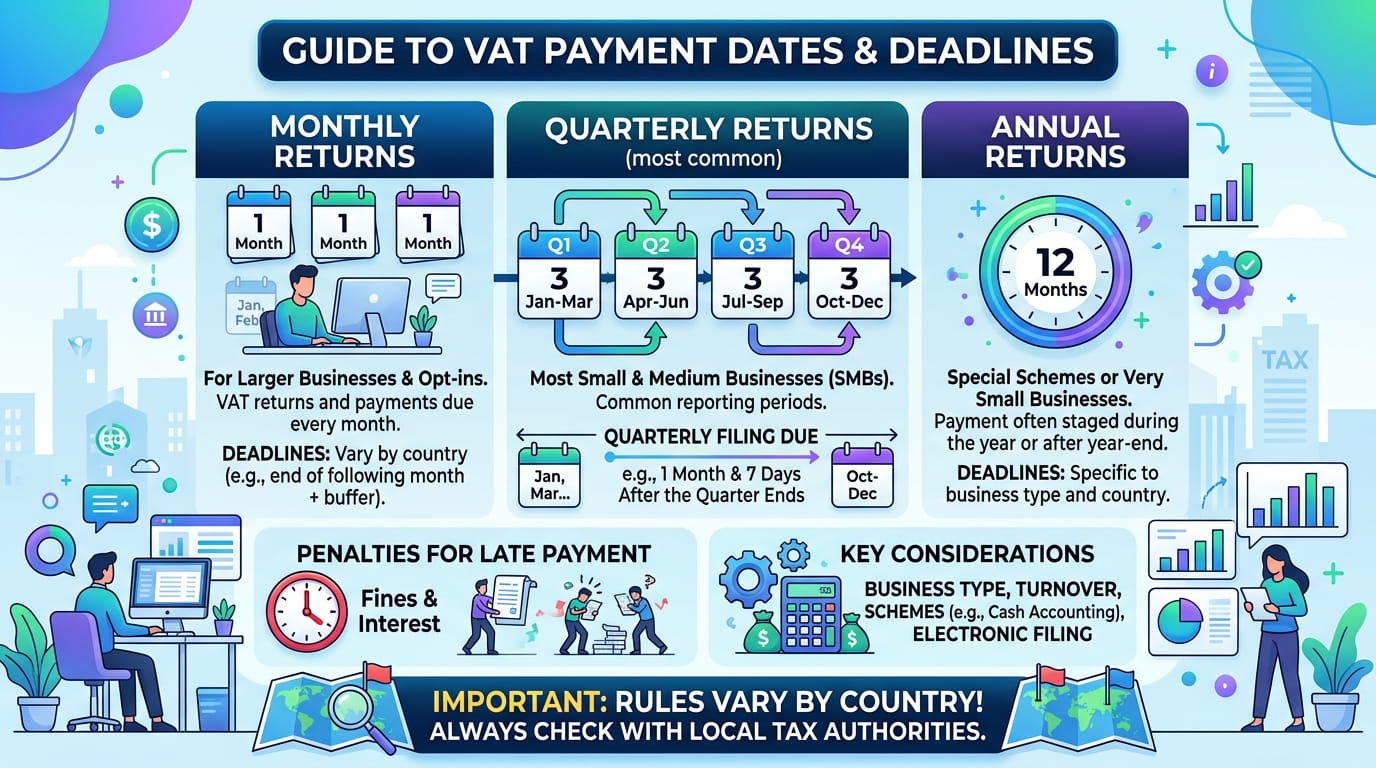
VAT Payment Dates are one of the most important parts of VAT compliance for UK businesses. If a business misses a VAT return or payment deadline, it may face penalties, interest, cash flow problems, and extra stress from HMRC.
For most UK VAT registered businesses, HMRC says the VAT return deadline is usually one calendar month and seven days after the end of the VAT accounting period. This is also normally the deadline for paying HMRC, and businesses must allow enough time for the payment to clear.
Adam Accountancy helps UK business owners understand VAT rules, submit returns correctly, and manage tax deadlines with confidence. Whether you run a limited company, sole trader business, charity, property business, or growing online service, VAT planning should never be left until the final day.
This guide explains VAT timing in simple language. It covers filing dates, payment rules, quarterly returns, annual accounting, penalties, Direct Debit, Making Tax Digital, bookkeeping, and professional accountant support.
The goal is to help you understand the full process, not just the deadline. VAT is easier to manage when your records, software, cash flow, and accountant are all working together.
What Are VAT Payment Dates?
vat payment dates are the dates by which a VAT registered business must pay VAT owed to HMRC. These dates normally depend on the end date of the business’s VAT accounting period.
For many businesses, VAT periods are quarterly. This means the business submits a VAT return every three months and pays the VAT due after that period ends.
The payment date is not only about sending money. It is about making sure the money reaches HMRC on time.
A late payment can still happen if a business sends the money on the deadline but the bank transfer does not clear in time. This is why HMRC tells businesses to allow time for payments to reach its account.
A clear VAT calendar helps business owners avoid confusion. It also helps them prepare the correct VAT return, review figures, and arrange payment before the final day.
Adam Accountancy supports businesses by checking accounting periods, preparing VAT figures, and helping clients avoid missed deadlines.
Why VAT Timing Matters
VAT timing matters because VAT money is not business profit. It is tax collected on behalf of HMRC.
Many business owners make the mistake of treating VAT received from customers as available cash. This can create problems when the payment deadline arrives.
A business may look profitable but still struggle if it has not set aside enough VAT funds. This is especially common for growing companies, contractors, online sellers, consultants, and service businesses.
Good VAT timing helps with:
- Cleaner cash flow
- Fewer HMRC problems
- Better financial planning
- Reduced stress near deadlines
- More accurate bookkeeping
A professional small business accountant can help forecast VAT liabilities throughout the year. This gives the business owner time to prepare instead of reacting at the last moment.
Adam Accountancy encourages clients to review VAT regularly, not only at the end of the quarter.
Understanding the VAT Payment Date
The vat payment date is the final date by which VAT owed to HMRC should reach HMRC’s account. It is usually the same as the VAT return deadline for standard VAT accounting periods.
For example, if a VAT quarter ends on 31 March, the deadline is usually 7 May. This gives one calendar month plus seven days after the end of the accounting period.
This rule is simple once you understand the pattern. However, mistakes happen when businesses use the invoice date, month-end date, or bank payment date incorrectly.
The safest approach is to check the VAT online account and confirm the official deadline before submitting the return.
A VAT accountant can also check the exact date and ensure the business does not rely on guesswork.
Adam Accountancy helps clients review VAT periods, confirm HMRC due dates, and plan payments in advance.
VAT Deadlines and Business Risk
vat deadlines are not just admin dates. They are compliance dates that affect the business’s relationship with HMRC.
If VAT is filed or paid late, the business may face late payment penalties, interest, and notices from HMRC. Since January 2023, VAT late payment penalties apply to VAT accounting periods that start on or after that date.
Late VAT can also create internal pressure. Directors, finance teams, and business owners may need to rearrange cash flow quickly.
Common risks include:
- Paying suppliers before reserving VAT money
- Forgetting the deadline after a busy sales period
- Submitting figures late because records are incomplete
- Assuming Direct Debit is active when it is not
- Waiting too long to ask for accountant support
Adam Accountancy helps businesses manage these risks by building a proper VAT workflow.
VAT Tax Payment Due Date Explained
The vat tax payment due date is the date by which VAT must be paid to HMRC. In normal quarterly VAT situations, it is usually one month and seven days after the VAT period ends.
This date should be treated as a cleared payment deadline, not a transfer instruction date.
If payment is made by Faster Payments, it usually reaches HMRC on the same or next day. CHAPS usually reaches HMRC the same working day if sent within bank processing times, while Bacs usually takes three working days.
Because banks have cut off times and limits, a business should never wait until the last minute.
A good rule is to prepare the VAT return early, review the numbers, and arrange payment several days before the final date.
Adam Accountancy can help create a payment schedule so VAT is planned before the deadline arrives.
When Is VAT Due for Payment?
Many UK business owners ask, when is vat due for payment after a VAT period ends? The usual answer is one calendar month and seven days after the end of the VAT accounting period.
For example, if the VAT period ends on 30 June, the usual payment deadline is 7 August.
If the VAT period ends on 31 December, the usual deadline is 7 February.
The exact date should always be checked through the VAT online account because special schemes, non-standard periods, or annual accounting can change the timing.
Adam Accountancy recommends using three checks:
- Confirm the VAT period end date.
- Check the VAT online account deadline.
- Make sure payment reaches HMRC before the deadline.
This simple process helps prevent missed payments and avoidable penalties.
VAT Filing Due Date
The vat filing due date is the date by which the VAT return must be submitted to HMRC. For most standard VAT returns, this is also the payment deadline.
Filing late can create problems even if the business has enough money to pay VAT. HMRC needs the return to calculate the liability and monitor compliance.
Businesses should not wait until the payment is ready before preparing the return. The return can be prepared early, reviewed, and then submitted when the figures are confirmed.
Good bookkeeping makes the filing process easier. Poor bookkeeping can delay the return and lead to rushed decisions.
Adam Accountancy supports clients by checking invoices, bank records, sales entries, purchase records, and VAT codes before submission.
The aim is not only to file on time but to file correctly.
Payment Dates for VAT
payment dates for vat depend on the accounting period and the VAT scheme used by the business. Most VAT registered businesses file quarterly, but some use monthly or annual arrangements.
A standard quarterly VAT example may look like this:
- Period ending 31 March: payment usually due 7 May
- Period ending 30 June: payment usually due 7 August
- Period ending 30 September: payment usually due 7 November
- Period ending 31 December: payment usually due 7 February
These dates are examples based on the usual rule. The VAT online account remains the best place to check the actual deadline.
Businesses using annual accounting or payments on account may have different payment patterns.
Adam Accountancy helps businesses choose suitable VAT processes based on cash flow, business type, and reporting needs.
VAT Return Due Date
The vat return due date is the final date for submitting the VAT return. It is important because VAT compliance depends on both submission and payment.
A business cannot simply pay an estimated amount and ignore the return. The return shows output VAT, input VAT, adjustments, and the amount due or repayable.
The return should be prepared from proper digital records where Making Tax Digital applies. HMRC says VAT registered businesses should keep digital records and submit VAT returns using compatible software unless exempt.
A clean VAT return depends on accurate bookkeeping throughout the period.
Adam Accountancy helps businesses reduce errors by reviewing transactions before submission. This is especially useful where there are mixed VAT rates, imports, exports, property transactions, or exempt income.
A good VAT return process is planned, checked, and documented.
VAT Payment Deadline
A vat payment deadline should be treated as a hard business date. It is not a reminder date or a rough estimate.
The payment must reach HMRC by the deadline. If the business uses Bacs, it should allow three working days. If it uses Direct Debit, the setup and collection timing must be checked.
HMRC says a Direct Debit should be set up at least three working days before submitting the VAT return. If it is not set up in time, the payment may not be taken and another payment method may be needed.
Businesses should also check whether an old Direct Debit is still active. HMRC notes that if a Direct Debit has not been used for two years or more, the business should check with the bank.
Adam Accountancy helps clients avoid payment method mistakes before the deadline arrives.
VAT Due Date
The vat due date is a phrase many business owners use to mean the VAT return and VAT payment deadline. In practice, it means the date when HMRC expects the return and payment.
The exact due date depends on the VAT period and scheme. It may also be affected by payment method, bank processing, or HMRC account settings.
A business should never rely only on memory. It should check the HMRC VAT online account, accounting software, and accountant’s deadline reminders.
The VAT due date should also be added to the company’s cash flow forecast. This helps the business avoid spending VAT money before it is paid to HMRC.
Adam Accountancy helps businesses understand their due dates and plan for them properly.
When VAT is planned early, the deadline becomes a routine process instead of a stressful event.
VAT Due Dates Across the Year
vat due dates usually follow a regular pattern, but each business can have different VAT periods.
One business may have quarters ending March, June, September, and December. Another may have quarters ending January, April, July, and October.
Because of this, two businesses in the same industry may have different deadline dates.
This is why generic calendars can be risky. They are useful for examples, but the VAT online account gives the official dates.
A business should create its own VAT schedule with:
- VAT period start date
- VAT period end date
- Internal bookkeeping cut off
- Review date
- Submission date
- Payment date
- Confirmation record
Adam Accountancy can help build a VAT calendar that matches the business’s actual HMRC periods.
Standard Quarterly VAT Example
A quarterly VAT cycle is the most common structure for UK VAT registered businesses.
Here is a simple example.
- The VAT quarter runs from 1 January to 31 March.
- The VAT period ends on 31 March.
- The return is prepared in April.
- The usual submission deadline is 7 May.
- The VAT payment should reach HMRC by 7 May.
This example shows why April bookkeeping matters. If records are not ready in April, the business may rush close to the deadline.
The business should review sales invoices, purchase invoices, bank feeds, expense claims, credit notes, and VAT codes before the return is submitted.
Adam Accountancy helps businesses create a month-end routine so VAT return preparation is smoother.
A good quarterly system reduces the chance of errors and late payments.
Monthly VAT Returns
Some businesses submit VAT returns monthly. This may happen when the business usually receives VAT repayments or wants more frequent VAT reporting.
Monthly returns can improve cash flow for businesses that regularly reclaim VAT. However, they also require more frequent bookkeeping discipline.
A monthly VAT cycle means the business has less time between returns. Records must be updated regularly, not only at quarter-end.
This structure may suit exporters, businesses with high input VAT, or companies investing heavily in equipment.
However, it may not suit every business. More frequent returns can mean more admin and higher compliance workload.
Adam Accountancy can review whether monthly returns make sense for the business.
The right VAT cycle should match cash flow, business activity, and HMRC requirements.
Annual Accounting Scheme
The Annual Accounting Scheme allows eligible businesses to submit one VAT return each year and make advance VAT payments during the year.
This can reduce the number of VAT returns, but it does not remove the need to pay VAT. It changes the timing and structure of payments.
HMRC says that under the Annual Accounting Scheme, if the accounting period is between 4 and 12 months long, the VAT return is due two months after the end of the accounting period.
This scheme may help businesses that prefer predictable instalments. However, it may not be suitable where turnover changes sharply.
Adam Accountancy can help assess whether annual accounting supports or harms cash flow.
A business should understand the payment pattern before joining any VAT scheme.
VAT Payments on Account
Larger VAT registered businesses may need to make VAT payments on account. These are advance payments toward the VAT bill.
HMRC says payments on account can apply where a business sends quarterly VAT returns and owes more than £2.3 million in VAT in a 12 month period or less.
This is not relevant for every small business, but it matters for larger companies and fast growing organisations.
Payments on account create a different cash flow pattern. Instead of paying VAT only after each quarter, the business may make interim payments during the quarter.
Adam Accountancy can help businesses understand whether this regime applies and how to prepare for it.
Large businesses should not wait for HMRC notices before planning cash flow.
VAT Registration and Threshold Planning
VAT registration is required when taxable turnover goes above the VAT registration threshold. The UK VAT taxable turnover threshold increased to more than £90,000 from 1 April 2024.
This threshold is important because VAT obligations begin once the business must register.
Many growing businesses focus on sales but forget to monitor rolling 12 month taxable turnover. That can lead to late registration and backdated VAT liabilities.
Adam Accountancy helps businesses review turnover and plan registration at the right time.
Registration planning should include:
- Pricing strategy
- Customer type
- VAT rates
- Software setup
- Record keeping
- Filing deadlines
- Cash flow impact
A small business accountant can be especially useful when a business is close to the VAT threshold.
Making Tax Digital for VAT
Making Tax Digital changed how VAT records and returns are handled. Most VAT registered businesses must keep digital records and file VAT returns using compatible software.
HMRC guidance says VAT registered businesses should use compatible software to keep records and submit returns under Making Tax Digital unless they are exempt.
This means businesses should not rely only on manual spreadsheets or paper records without checking compliance.
Digital bookkeeping helps reduce errors, but software still needs proper setup. Incorrect VAT codes can create wrong returns even when software is used.
Adam Accountancy helps clients choose suitable software, review VAT settings, and maintain clean digital records.
Good software supports compliance, but professional review supports accuracy.
VAT Rates and Food Queries
VAT rules vary depending on the goods or services sold. The standard VAT rate is 20%, the reduced rate is 5%, and some items are zero rated. HMRC lists most food and children’s clothes as examples of zero rated goods.
This is why searches like vat on supermarket food uk are common. Food VAT can be confusing because some products are zero rated, some are standard rated, and some depend on how they are supplied.
Businesses selling food should not guess VAT treatment. Cafes, supermarkets, caterers, online food retailers, and hospitality businesses may need detailed guidance.
Adam Accountancy can help review VAT rates for different products and services.
Incorrect VAT rates can affect pricing, margins, returns, and HMRC compliance.
How to Check Your VAT Deadline
Every VAT registered business should know where to check its official deadline.
The safest place is the HMRC VAT online account. It shows when returns are due and when payment must clear HMRC’s account.
Accounting software may also show the deadline, but it should match HMRC records.
A simple checking process is useful:
- Log into the VAT online account.
- Check the open VAT period.
- Confirm the return deadline.
- Confirm the payment deadline.
- Record the deadline in a calendar.
- Set an internal reminder before the deadline.
Adam Accountancy recommends setting internal deadlines earlier than HMRC deadlines.
This creates time for review and correction.
How to Pay VAT to HMRC
Businesses can pay VAT using several methods, including Direct Debit, Faster Payments, CHAPS, Bacs, and other approved payment options.
The method matters because clearing times are different.
Faster Payments usually reach HMRC on the same or next day, including weekends and bank holidays. CHAPS is usually same working day if sent within the bank’s processing times. Bacs normally takes three working days.
A business should check its bank limits before making a large VAT payment. Some banks have daily transfer limits that can delay payment.
Adam Accountancy encourages businesses to plan payment before the final day.
A payment confirmation should be saved with VAT records.
Direct Debit for VAT
Direct Debit can make VAT payment easier, but it must be set up correctly.
HMRC says the Direct Debit should be set up at least three working days before submitting the VAT return. If not, the payment may not be taken and the business may need another payment method.
This is important for new VAT registered businesses. It is also important where a business has not used Direct Debit recently.
The business should check:
- Direct Debit setup date
- Bank account details
- Return submission date
- Expected collection date
- Available funds
A Direct Debit is not a reason to ignore VAT cash flow.
Adam Accountancy can help clients check payment arrangements before submitting the return.
Late VAT Payment Penalties
Late VAT payment can result in penalties. The current VAT penalty system applies to accounting periods starting on or after 1 January 2023.
HMRC’s late payment penalty rules are designed to encourage quick action. The longer VAT remains unpaid, the more serious the problem becomes.
A business should contact HMRC early if it cannot pay on time. Waiting until the debt becomes older can increase pressure.
Adam Accountancy can help clients review options, prepare figures, and understand HMRC communication.
Common reasons for late VAT include:
- Poor cash flow planning
- Missed payment reminder
- Wrong bank reference
- Software delay
- Direct Debit failure
- Incomplete bookkeeping
Late payment is easier to prevent than fix.
VAT Late Payment Interest
HMRC can charge late payment interest when VAT is not paid on time. HMRC says late payment interest is charged from the first day the VAT payment is overdue until it is paid in full.
Interest can make a VAT debt more expensive. Even a short delay may create extra cost and admin.
A business should treat VAT as a priority payment. It should not wait until HMRC sends a reminder.
If cash flow is tight, the business should prepare early and seek advice.
Adam Accountancy helps businesses understand their VAT liability before the payment deadline. This gives owners more time to act if funds are short.
Clear records, early review, and realistic planning reduce the risk of late interest.
What If You Cannot Pay VAT on Time?
If a business cannot pay VAT on time, it should not ignore the issue.
The first step is to check the exact amount due. The second step is to understand why the cash is not available. The third step is to speak to HMRC or a professional adviser before the problem grows.
A business may need to consider a Time to Pay arrangement, but this depends on circumstances and HMRC approval.
Adam Accountancy can help prepare the figures before the business contacts HMRC.
Useful preparation includes:
- VAT return amount
- Cash flow forecast
- Bank position
- Customer debts
- Supplier commitments
- Reason payment cannot be made
- Proposed payment plan
Professional preparation can make the conversation clearer.
Common VAT Deadline Mistakes
Many VAT problems happen because of simple process failures.
Common mistakes include:
- Recording the wrong VAT quarter
- Confusing filing date with payment processing date
- Leaving bookkeeping until the final week
- Using incorrect VAT codes
- Assuming the accountant has all records
- Forgetting to approve the VAT return
- Paying HMRC with the wrong reference
- Not checking bank transfer limits
These mistakes can affect any business. They are not limited to new companies.
Adam Accountancy helps businesses build repeatable systems so the same mistakes do not happen every quarter.
A reliable VAT process should include internal deadlines, review points, software checks, and payment confirmation.
VAT compliance is easier when it becomes a routine.
Building a VAT Calendar
A VAT calendar is one of the simplest tools a business can use.
It should include more than the final deadline. It should include the dates needed to prepare, check, and approve the return.
A good VAT calendar includes:
- Period start date
- Period end date
- Bookkeeping cut off date
- Records review date
- Accountant review date
- Return approval date
- Payment setup date
- Final HMRC deadline
This reduces last minute pressure.
Adam Accountancy can help create a VAT calendar that fits the business’s actual workflow.
For example, if the final deadline is 7 May, the internal bookkeeping cut off may be 15 April and the return review date may be 25 April.
Earlier preparation creates safer compliance.
Cash Flow Planning for VAT
VAT planning is also cash flow planning.
A business should not wait until the return is complete before thinking about payment. It should estimate VAT throughout the quarter.
A practical method is to set aside VAT regularly. Some businesses use a separate bank account for VAT funds.
This can prevent VAT money from being used for rent, wages, stock, advertising, or supplier payments.
Adam Accountancy often advises business owners to review VAT liability monthly.
A simple monthly review can show whether the quarter is likely to produce a high VAT payment.
Good cash flow planning includes:
- Sales forecast
- Purchase forecast
- VAT estimate
- Payroll costs
- Corporation tax planning
- Supplier payment dates
- Customer payment timing
VAT should be part of the full financial picture.
Bookkeeping and VAT Accuracy
Accurate bookkeeping is the foundation of accurate VAT returns.
If the books are messy, the VAT return is likely to be delayed or wrong. Missing invoices, duplicate expenses, and incorrect VAT codes can all affect the final figure.
Bookkeeping should be updated regularly, not only near the deadline.
Professional bookkeeping accountants can help businesses maintain clean records throughout the year.
Adam Accountancy supports clients by reviewing sales, purchases, bank feeds, receipts, credit notes, and adjustments.
Good bookkeeping helps with:
- Faster VAT returns
- Better cash flow forecasts
- Fewer VAT errors
- Clearer audit trail
- Easier year end accounts
- Better management decisions
VAT is not only a tax task. It is a record keeping task.
Choosing a VAT Accountant
A VAT accountant helps businesses understand VAT rules, prepare returns, review transactions, and plan payments.
This is especially useful when a business has complex sales, mixed VAT rates, international transactions, property income, or fast growth.
Adam Accountancy provides VAT support for UK businesses that want professional guidance and reliable filing processes.
A good adviser can help with:
- VAT registration
- VAT return preparation
- VAT scheme review
- VAT rate checks
- HMRC deadline planning
- Digital record keeping
- Penalty prevention
- Cash flow forecasting
Not every VAT issue is obvious. Some mistakes only appear when records are reviewed carefully.
Professional support can save time and reduce risk.
Support from Adam Accountancy
Adam Accountancy helps business owners manage VAT with confidence.
The service is designed for businesses that want clear explanations, accurate records, and professional support before deadlines become urgent.
VAT support may include reviewing bookkeeping, checking VAT codes, preparing returns, confirming deadlines, and advising on payments.
The firm can also help business owners understand how VAT connects with other taxes.
For example, VAT may affect pricing, profit, cash flow, payroll decisions, corporation tax planning, and director drawings.
Adam Accountancy focuses on practical advice. The goal is to help clients stay compliant and understand their numbers.
VAT is easier when business owners know what is due, when it is due, and how to prepare.
VAT for Small Businesses
VAT can feel difficult for small businesses because owners often manage sales, customers, staff, suppliers, and admin at the same time.
A small business accountant can help organise the process so VAT does not become overwhelming.
Small businesses should pay attention to turnover, VAT registration, software setup, pricing, and quarterly cash flow.
Adam Accountancy supports small businesses by creating simple, repeatable VAT systems.
A small business accountant can also help owners understand whether VAT registration changes pricing or profit margins.
For example, a business selling mostly to consumers may feel VAT differently from a business selling to VAT registered customers.
A small business accountant can explain these differences clearly.
VAT should not be ignored until registration becomes urgent.
VAT for Limited Companies
Limited companies often have several tax obligations at the same time. VAT is only one part of the wider compliance picture.
A limited company may also need corporation tax returns, payroll submissions, annual accounts, confirmation statements, and dividend planning.
Corporation tax accountants can help directors understand how VAT fits with business profit and tax planning.
Adam Accountancy supports limited companies by helping directors organise VAT deadlines alongside other accounting responsibilities.
Corporation tax accountants may also review whether business spending is properly recorded and whether VAT has been reclaimed correctly.
A limited company should avoid risky advice about limited company tax loopholes. Professional tax planning is different from aggressive or unclear schemes.
Adam Accountancy focuses on compliant, practical planning that protects the business.
VAT for Sole Traders
Sole traders may need VAT support when turnover grows or when they sell taxable goods and services.
VAT can be confusing because sole traders also deal with self assessment. The business owner must keep accurate records for both VAT and income tax.
A self assessment accountant can help align VAT records with annual tax reporting.
Adam Accountancy helps sole traders understand VAT registration, filing, payment planning, and digital records.
A self assessment accountant can also explain how VAT payments differ from income tax payments.
Sole traders should not mix personal spending, business spending, and VAT records without a clear system.
A self assessment accountant can help create better separation between business accounts and personal finances.
Clean records make both VAT and self assessment easier.
VAT for Landlords and Property Businesses
Property VAT can be complex. Some property transactions are exempt, some may involve options to tax, and some may require specialist advice.
Landlords should be careful when dealing with commercial property, serviced accommodation, property development, or business premises.
Landlord accountants can help property owners understand record keeping, tax planning, and VAT treatment.
Adam Accountancy provides support where property income connects with VAT, income tax, capital gains, and company structures.
Property tax advice is important because property decisions can have long term tax effects.
Landlord accountants can also help owners separate rental income, repairs, finance costs, and business expenses.
The right property tax advice can reduce confusion and help landlords avoid mistakes.
VAT should be reviewed before major property decisions are made.
VAT and Capital Gains Planning
VAT is not the same as capital gains tax, but business owners often need to consider several taxes together.
For example, selling a business asset may create accounting, VAT, and capital gains questions.
Capital gains tax accountants can help review the tax impact of selling assets, shares, property, or business interests.
Adam Accountancy helps clients understand when specialist tax planning is needed.
Capital gains tax accountants may be relevant when a business owner sells commercial property or reorganises ownership.
VAT treatment should be reviewed separately because VAT rules do not always follow capital gains rules.
Capital gains tax accountants and VAT advisers may need to work together on complex transactions.
Good advice before a sale can prevent expensive surprises later.
VAT and Inheritance Tax Planning
Business owners sometimes think only about current VAT returns, but long term tax planning can also matter.
An inheritance tax advisor can help families think about succession, business assets, property, and estate planning.
Adam Accountancy can support clients by identifying when wider advice may be needed.
An inheritance tax advisor may be useful where business ownership, family companies, property portfolios, or high value assets are involved.
Some clients also search for inheritance tax summary form guidance when dealing with estate matters.
VAT does not replace inheritance tax advice, and inheritance tax does not replace VAT compliance.
They are different areas, but both need accurate records and careful planning.
An inheritance tax advisor can help families think ahead, while VAT support keeps the current business compliant.
VAT and Payroll Services
Payroll and VAT are separate areas, but they both affect cash flow.
A business that pays staff must plan wages, PAYE, National Insurance, pension contributions, and VAT payments.
Payroll services help employers manage staff pay correctly and on time.
Adam Accountancy can help businesses coordinate payroll services with tax planning and bookkeeping.
This matters because VAT payments can fall close to payroll dates. Without planning, the business may face pressure from several payment obligations at once.
Payroll services also support accurate financial records because wages and employer costs need to be posted correctly.
A business should look at VAT, payroll, and supplier payments together.
Strong financial planning reduces deadline stress.
VAT for Charities
Charities can have specific VAT issues depending on their activities, income types, grants, trading, and fundraising.
Charity accountants can help trustees understand VAT, accounts, reporting, and compliance.
HMRC says a VAT registered charity must charge VAT on standard rated and reduced rated goods and services it sells, while some non-business, zero rated, or exempt income may be treated differently.
This makes VAT treatment more complex than many trustees expect.
Adam Accountancy can help charities review records and understand when specialist VAT guidance is needed.
Charity accountants can support trustees with reporting, governance, and tax compliance.
A charity should not assume all income is outside VAT.
Charity accountants can help review each income stream carefully.
VAT on Supermarket Food UK
The phrase vat on supermarket food uk is common because food VAT rules can be confusing.
In the UK, many basic food items are zero rated, but some food and drink products may be standard rated depending on type, packaging, temperature, or supply method.
This is why businesses should not guess VAT treatment from common sense alone.
A supermarket, food wholesaler, online food shop, cafe, or catering business may need professional VAT review.
Adam Accountancy can help business owners understand product categories and check VAT rates.
Searches for vat on supermarket food uk show that consumers and business owners both want clarity.
The key point is simple: food VAT needs product specific checking.
If a business sells food, VAT accuracy can directly affect pricing and profit.
Online Tax Services and VAT
Online tax services can make VAT support more accessible for businesses across the UK.
A business owner no longer needs to visit an office for every VAT question. Records can be shared digitally, software can be reviewed remotely, and deadlines can be managed online.
Adam Accountancy provides professional support that can work alongside cloud bookkeeping and digital tax systems.
Online tax accountants can help with VAT returns, self assessment, corporation tax, payroll, and bookkeeping.
Online tax services are especially useful for busy business owners who want support without long meetings.
However, online does not mean informal. VAT work still needs accuracy, professional judgement, and proper records.
Online tax accountants should understand HMRC rules and practical business needs.
Good digital support can save time and improve compliance.
Accountants in Slough and Berkshire
Businesses looking for accountants in Slough often need help with VAT, bookkeeping, payroll, and tax returns.
Adam Accountancy supports UK businesses with practical accounting and tax guidance.
A chartered accountant Berkshire search often comes from business owners who want professional support in or around the Berkshire area.
Accountants Slough searches may also come from sole traders, landlords, limited companies, and growing local firms.
Whether support is local or online, the important thing is reliable advice and clear communication.
Adam Accountancy helps clients understand deadlines, prepare records, and avoid rushed filings.
Businesses searching for accountants in Slough should choose advisers who understand VAT as well as wider tax planning.
A good accountant should explain the numbers in plain English.
Specialist Tax Searches and VAT
Business owners often search for different tax topics at the same time.
For example, someone may need a forex accountant UK service if they trade internationally, deal with currency gains, or record foreign income.
Others may search for stamp duty on transfer of equity when property ownership changes.
Some search for stamp duty on a transfer of equity because they want to understand property transaction costs.
Adam Accountancy can help identify when specialist advice is needed and when different taxes connect.
A VAT issue may sit alongside property tax, personal tax, company tax, or international tax.
Professional guidance helps business owners avoid treating every tax question as separate.
Tax decisions often overlap, especially for companies, landlords, and investors.
Personal Tax Account HMRC and VAT
A personal tax account HMRC login is useful for individual tax matters, but VAT is usually managed through business tax services.
This distinction matters because business owners sometimes look in the wrong place for VAT information.
VAT registered businesses should use the correct VAT online account to check returns, deadlines, and payments.
Adam Accountancy can help clients understand which HMRC account applies to which tax.
A personal tax account HMRC service may help with income tax, National Insurance, PAYE information, and personal details.
VAT records are business records and should be managed separately.
Using the correct account reduces confusion and helps the business find accurate deadline information.
Good tax management starts with knowing where each obligation is recorded.
Limited Company Tax Loopholes and VAT Risk
Searches for limited company tax loopholes are common, but business owners should be careful.
There is a big difference between legal tax planning and risky tax avoidance. A professional accountant should help clients stay compliant, not push unclear schemes.
Adam Accountancy focuses on practical and responsible advice.
VAT errors can happen when directors chase shortcuts instead of maintaining accurate records.
Limited company tax loopholes may sound attractive online, but poor advice can create HMRC problems.
A better approach is to plan properly, claim legitimate expenses, maintain accurate VAT records, and meet deadlines.
Corporation tax accountants can help directors understand tax planning in a compliant way.
Good advice protects both the business and the director.
VAT Records Businesses Should Keep
VAT registered businesses should keep clear records of sales, purchases, VAT charged, VAT reclaimed, credit notes, and adjustments.
Digital records are usually required under Making Tax Digital rules unless the business is exempt.
Useful VAT records include:
- Sales invoices
- Purchase invoices
- Bank statements
- Expense receipts
- Import documents
- Export evidence
- Credit notes
- VAT calculations
- Return submission confirmations
- Payment confirmations
Adam Accountancy helps businesses organise records so returns can be prepared without panic.
Good records also help answer HMRC questions if a return is checked.
VAT records should be clear, complete, and easy to trace.
When records are organised during the period, deadline work becomes much easier.
VAT Software Setup
VAT software can save time, but only when it is set up correctly.
Common setup problems include wrong VAT rates, incorrect bank feeds, duplicate suppliers, missing invoice numbers, and poor category mapping.
A business should review software settings before relying on automatic VAT reports.
Adam Accountancy helps clients review VAT codes, chart of accounts, invoice settings, and reporting periods.
Software should support the business, not create hidden errors.
Useful checks include:
- Is the VAT registration number correct?
- Are VAT periods set correctly?
- Are standard, reduced, zero, and exempt codes clear?
- Are bank feeds reconciled?
- Are old transactions locked after filing?
- Are adjustments documented?
Good setup prevents future confusion.
VAT for Online Sellers
Online sellers often face VAT complexity because they may sell through websites, marketplaces, social media, and international platforms.
Sales channels should be reconciled carefully. Marketplace fees, refunds, discounts, and shipping income can all affect records.
Adam Accountancy helps online sellers understand VAT records and payment planning.
Online sellers should check whether sales reports match bank receipts. Differences can occur because platforms deduct fees before paying out.
A VAT return should be based on accurate sales and purchase information, not rough bank totals.
Online tax accountants can be useful for e-commerce businesses because records are already digital.
A good system connects sales platforms, accounting software, bank feeds, and VAT reporting.
VAT for Service Businesses
Service businesses may think VAT is simple, but errors still happen.
Consultants, agencies, designers, developers, tradespeople, and professional service firms must understand when to charge VAT and how to record expenses.
Adam Accountancy supports service businesses by reviewing sales invoices and expense claims.
A service business should be especially careful with overseas clients, subcontractors, software subscriptions, and mixed business expenses.
The VAT return should match the business model.
A small agency may have different VAT issues from a construction contractor or financial consultant.
A professional VAT accountant can review the details and explain what applies.
Service businesses should also plan VAT cash flow because VAT collected from clients can build quickly.
VAT for Contractors and Trades
Contractors and trades businesses often deal with materials, labour, subcontractors, vans, equipment, and job related expenses.
This can make VAT records detailed.
Adam Accountancy helps contractors keep accurate VAT records and understand payment timing.
Trades businesses should keep purchase invoices for materials and tools. They should also record customer invoices correctly.
If the business uses subcontractors, the accounting treatment should be reviewed carefully.
VAT mistakes can happen when job costs are recorded late or when receipts are missing.
Bookkeeping accountants can help trades businesses keep records clean during the quarter.
A regular bookkeeping routine prevents a last minute pile of paperwork before the deadline.
VAT for Property Developers
Property development can involve complex VAT issues.
New builds, conversions, commercial property, residential property, land, and professional fees may all have different VAT treatment.
A business should take property tax advice before starting a major project.
Adam Accountancy can help identify when specialist VAT and property guidance is needed.
Landlord accountants may also support clients who move from simple rental income into development or serviced accommodation.
VAT should be reviewed before pricing, contracts, and funding decisions are finalised.
Property tax advice can help avoid mistakes that are difficult to correct later.
VAT is not only a return filing issue in property. It can affect project cost and profitability from the beginning.
VAT and Business Growth
As a business grows, VAT becomes more important.
Higher turnover means larger VAT liabilities, more transactions, and greater cash flow pressure.
Adam Accountancy helps growing businesses move from informal record keeping to structured finance systems.
Growth can create problems if the business does not improve its bookkeeping.
Signs that VAT systems need improvement include:
- Late invoice processing
- Unreconciled bank feeds
- Missing receipts
- Unclear VAT codes
- Cash flow surprises
- Missed internal deadlines
- Too much manual work
A growing business should not use startup level systems forever.
As turnover increases, VAT discipline should increase too.
VAT and Pricing Strategy
VAT affects pricing, especially when customers are not VAT registered.
If a business sells mainly to consumers, adding VAT can make prices look higher or reduce margins if prices stay the same.
If a business sells mainly to VAT registered companies, customers may be able to reclaim VAT, so the commercial effect may be different.
Adam Accountancy helps business owners think through pricing before and after VAT registration.
A small business accountant can help model the impact on profit.
Pricing should consider:
- VAT rate
- Customer type
- Competitor pricing
- Gross margin
- Payment terms
- Cash flow
- Business growth plans
VAT registration should be treated as a business planning issue, not only a tax form.
VAT and Invoice Timing
Invoice timing can affect VAT reporting.
Under standard VAT accounting, VAT is generally based on invoice dates rather than when the customer pays, unless a special scheme such as cash accounting applies.
This means a business may owe VAT before it receives payment from the customer.
Adam Accountancy can help businesses review whether cash accounting may be useful where eligible.
Cash flow problems often happen when customers pay late but VAT must still be paid.
Businesses should manage payment terms carefully.
Useful steps include:
- Clear invoice terms
- Prompt invoice sending
- Credit control
- Deposit requests
- Payment reminders
- Regular debtor review
VAT planning should include customer payment behaviour.
VAT Cash Accounting
The VAT Cash Accounting Scheme may help eligible businesses account for VAT based on payments received and made.
This can help cash flow where customers do not always pay quickly.
However, it may not suit every business. The effect depends on sales, purchases, payment timing, and business model.
Adam Accountancy can review whether cash accounting is suitable.
The scheme can be useful for service businesses, consultants, and smaller companies with delayed customer payments.
However, a business should understand the rules before switching.
Good advice is important because VAT schemes affect how returns are prepared.
A VAT accountant can compare standard accounting with cash accounting and explain the practical impact.
VAT Flat Rate Scheme
The Flat Rate Scheme may simplify VAT for some small businesses.
Under this scheme, eligible businesses pay a fixed percentage of gross turnover instead of calculating VAT on every sale and purchase in the normal way.
However, it does not automatically save money.
Adam Accountancy can help business owners compare the Flat Rate Scheme with standard VAT accounting.
The correct percentage depends on the business type. Limited cost trader rules may also affect whether the scheme is worthwhile.
A small business accountant can review expected sales, expenses, and VAT recovery before a decision is made.
The scheme should be chosen because it fits the business, not because it sounds simple.
VAT simplicity should still be financially sensible.
VAT Annual Accounting Pros and Cons
Annual accounting can reduce the number of VAT returns, but it changes the payment routine.
The business makes advance payments and submits one return each year.
This may help businesses that prefer predictable payments. It may also reduce admin.
However, it can be less suitable where turnover changes significantly.
Adam Accountancy can help businesses compare annual accounting with normal quarterly returns.
Possible benefits include:
- Fewer VAT returns
- More predictable instalments
- Less frequent filing pressure
Possible drawbacks include:
- Instalments may not match current trading
- Large balancing payments can occur
- Less frequent review may hide problems
The right scheme depends on cash flow and business stability.
How Adam Accountancy Reviews VAT Returns
Adam Accountancy follows a structured approach when reviewing VAT returns.
The process may include checking sales, purchases, bank records, VAT codes, adjustments, and previous return balances.
A professional review helps identify errors before submission.
The process may include:
- Confirming the VAT period.
- Checking bookkeeping completeness.
- Reviewing VAT control accounts.
- Checking high value transactions.
- Reviewing VAT rates.
- Confirming return figures.
- Checking deadline dates.
- Confirming payment arrangements.
This process helps the business avoid rushed filing.
VAT review is not only about submitting a number. It is about making sure the number is supported by records.
VAT Deadline Checklist
A VAT deadline checklist helps business owners stay organised.
Here is a simple checklist.
- Confirm the VAT period end date.
- Check HMRC’s official deadline.
- Reconcile all bank accounts.
- Upload missing purchase invoices.
- Check sales invoices.
- Review VAT codes.
- Check credit notes.
- Review unusual transactions.
- Confirm the VAT liability.
- Submit the VAT return.
- Arrange payment.
- Save payment confirmation.
Adam Accountancy can help businesses adapt this checklist to their own systems.
The checklist should be repeated every VAT period.
Consistency is more important than complexity.
A simple checklist used every time is better than a complicated system ignored under pressure.
Internal VAT Review Dates
Businesses should set internal review dates before HMRC’s final deadline.
For example, if the final VAT deadline is 7 May, the business might set 15 April as the bookkeeping cut off and 25 April as the review date.
This creates time to fix missing records.
Adam Accountancy encourages businesses to work ahead of HMRC deadlines.
Internal dates should be realistic and visible to the people responsible.
A small business may only need a simple calendar reminder. A larger business may need a finance team workflow.
Internal dates reduce the chance of last minute problems.
They also help accountants receive information early enough to review it properly.
VAT should not be treated as an emergency every quarter.
VAT Payment References
When paying HMRC, the payment reference matters.
Using the wrong reference can delay allocation and make it look like VAT is unpaid.
Businesses should use the correct VAT registration number or payment reference shown by HMRC.
Adam Accountancy recommends checking the reference before every payment.
This is especially important where a business pays multiple taxes, such as PAYE, corporation tax, VAT, and self assessment.
A payment confirmation should be saved after payment is made.
Good records include:
- Date paid
- Amount paid
- Payment method
- Bank account used
- Reference used
- Confirmation number
- Person who approved payment
This creates a clear audit trail.
VAT and Bank Holidays
VAT payments should be planned around weekends and bank holidays.
Even if online banking works outside normal hours, the business should check payment processing times and bank limits.
HMRC reminds businesses to allow time for payments to reach its account.
If the deadline is close to a bank holiday, businesses should pay earlier to reduce risk.
Adam Accountancy advises clients not to leave payments until the last day.
Bank delays, system errors, forgotten approvals, and transfer limits can all cause problems.
A payment made early is easier to manage than a payment made under pressure.
VAT compliance should build in a safety margin.
VAT Refunds and Repayment Returns
Some VAT returns result in repayment rather than payment.
This may happen where input VAT is higher than output VAT. It is common for some exporters, new businesses investing in equipment, or businesses with high purchase costs.
Even if no VAT is payable, the return still needs to be submitted.
Adam Accountancy helps businesses prepare repayment returns carefully because HMRC may review them.
The business should keep strong supporting records for input VAT claims.
A repayment return is not a reason to ignore the deadline.
Late submission can still create compliance problems.
Good bookkeeping helps HMRC process repayment claims more smoothly.
Businesses should make sure bank details and records are accurate.
VAT and Expense Claims
Expense claims can affect VAT returns.
If employees or directors pay business costs personally, the business should keep receipts and record claims correctly.
VAT can usually only be reclaimed where the business has valid evidence and the expense is for business purposes.
Adam Accountancy helps clients create expense processes that support VAT claims.
A business should avoid vague descriptions such as “miscellaneous” or “general cost.”
Clear records help the accountant decide whether VAT is reclaimable.
Useful expense rules include:
- Keep receipts
- Record business purpose
- Separate personal costs
- Submit claims monthly
- Use proper categories
- Review VAT codes
Good expense discipline improves VAT accuracy.
VAT and Supplier Invoices
Supplier invoices should be checked before VAT is reclaimed.
A valid VAT invoice usually needs key information such as supplier details, VAT number, invoice date, description, net amount, VAT amount, and total amount.
If invoice details are missing, VAT recovery may be questioned.
Adam Accountancy can help businesses understand what a proper VAT invoice should include.
This is important for high value purchases, subcontractor costs, equipment, software, and professional fees.
Businesses should store invoices digitally where possible.
Supplier statements alone are not always enough for VAT records.
Good invoice control prevents missing claims and unsupported claims.
VAT accuracy depends on evidence.
VAT and Customer Invoices
Customer invoices should show VAT correctly where VAT applies.
Errors on customer invoices can create problems for both the business and the customer.
A VAT registered business should check invoice templates, VAT number display, VAT rate, and total calculations.
Adam Accountancy helps clients review invoice setup in accounting software.
A customer invoice should be clear and professional.
Incorrect VAT invoices can lead to disputes, delayed payments, and return errors.
Businesses should also check whether invoices are dated correctly.
Invoice timing can affect the VAT period in which sales are reported.
Accurate invoicing supports accurate VAT returns.
VAT and Credit Notes
Credit notes can affect VAT returns because they adjust earlier invoices.
A business may issue a credit note for returns, discounts, errors, cancellations, or price changes.
Credit notes should be recorded in the correct VAT period.
Adam Accountancy helps businesses review credit notes before VAT return submission.
Missing credit notes can overstate VAT due. Incorrect credit notes can understate VAT due.
A clear process is needed.
The business should match each credit note to the original invoice where possible.
This helps maintain a proper audit trail.
Credit notes should not be left outside the accounting system.
VAT returns should reflect the true position after adjustments.
VAT and Bad Debts
Bad debt relief may be available where a customer has not paid, but rules must be followed.
A business should not simply remove unpaid invoices from VAT records without checking the correct treatment.
Adam Accountancy can help review unpaid customer invoices and explain possible options.
This is especially important for businesses with long payment terms or slow paying customers.
Credit control is part of VAT cash flow management.
If VAT has been paid to HMRC before the customer pays, late customer payment can create pressure.
A business should monitor aged debtors regularly.
Strong credit control reduces the risk of VAT being paid from cash the business has not received.
VAT and Imports
Businesses that import goods may have additional VAT considerations.
Import VAT, postponed VAT accounting, customs declarations, and shipping documents can affect VAT records.
Adam Accountancy can help businesses understand how import VAT appears in records.
Import documents should be stored carefully because they support VAT entries.
A business should reconcile import VAT statements with accounting software.
International trade can create more complex VAT reporting than domestic sales.
Businesses should seek advice before changing supply chains or selling into new markets.
Good import records reduce VAT return errors.
VAT on imports should not be guessed from bank payments alone.
VAT and Exports
Exports may have different VAT treatment from domestic sales.
Businesses need evidence to support export treatment and should keep shipping and customer records.
Adam Accountancy helps businesses review export documentation and VAT coding.
Online sellers and wholesalers should be especially careful where goods leave the UK.
Export evidence should be stored in a way that can be found later.
VAT treatment may depend on customer type, destination, goods, services, and transaction structure.
A business should not assume every overseas sale is treated the same.
Professional review can prevent undercharging or overcharging VAT.
International VAT mistakes can be costly.
VAT and International Services
Services supplied to overseas customers can involve complex VAT rules.
The place of supply rules may determine whether UK VAT is charged.
Adam Accountancy can help service businesses review overseas clients and invoice treatment.
This is common for consultants, designers, agencies, developers, coaches, and online service providers.
Businesses should collect enough customer information to support VAT treatment.
A simple invoice address may not always answer the VAT question.
International services should be reviewed before invoices are issued.
Correct treatment helps avoid later corrections.
As businesses grow internationally, VAT processes need to become stronger.
VAT and Construction Businesses
Construction businesses may face additional VAT issues, including domestic reverse charge rules in certain situations.
Contractors and subcontractors should understand how VAT applies to their invoices.
Adam Accountancy can help construction businesses review VAT coding and invoice wording.
Construction VAT mistakes can affect cash flow quickly because invoices are often high value.
A business should check each contract, customer type, and service type before issuing invoices.
Bookkeeping accountants can help keep project costs organised.
The finance process should capture materials, labour, subcontractor bills, plant hire, and retention amounts accurately.
VAT compliance in construction needs attention to detail.
VAT and Professional Services
Professional service firms may have simple sales but complex expenses.
For example, legal fees, software tools, subcontractors, travel, training, and overseas services may all affect VAT records.
Adam Accountancy supports professional firms with VAT returns and bookkeeping systems.
A VAT accountant can help review unusual transactions before the return is filed.
Professional service firms should also review work in progress, invoicing timing, and customer payment terms.
The aim is to avoid a large VAT surprise at the end of the quarter.
Service firms often collect VAT from clients before supplier bills and salaries are fully paid.
Cash flow discipline is important.
VAT and Retail Businesses
Retail businesses handle many transactions, refunds, discounts, and stock purchases.
VAT records should connect point of sale systems, bank receipts, merchant fees, and accounting software.
Adam Accountancy helps retail businesses review systems so VAT reports match real trading activity.
Retail VAT can be difficult where products have different rates.
This is why queries like vat on supermarket food uk appear regularly.
Retailers should check product VAT rates before selling, not after returns are due.
Incorrect rate setup in a till or online store can affect many transactions.
Regular review reduces the chance of repeated mistakes.
VAT and Restaurants or Cafes
Restaurants, cafes, takeaways, and food businesses often face VAT complexity.
Food supplied hot, cold, for takeaway, for catering, or as packaged goods may be treated differently.
Adam Accountancy can help food businesses review VAT categories.
The phrase vat on supermarket food uk also shows how food VAT can confuse both consumers and businesses.
Hospitality businesses should make sure tills, menus, apps, and accounting systems apply VAT correctly.
VAT mistakes in hospitality can build quickly because transaction volumes are high.
A food business should review VAT before launching new products or offers.
Professional support can protect margins and improve compliance.
VAT and E-commerce Marketplaces
E-commerce businesses selling through marketplaces must understand sales reports and VAT treatment.
Marketplace payouts may deduct fees before the money reaches the bank. This can make bank deposits lower than gross sales.
Adam Accountancy helps sellers reconcile marketplace reports with accounting software.
Online tax accountants can help sellers understand digital records, sales channels, and VAT returns.
E-commerce businesses should not base VAT returns only on bank deposits.
The correct figures usually come from detailed sales reports, fees, refunds, and tax data.
Online sellers should also monitor VAT registration thresholds carefully as sales can grow quickly.
Digital business needs digital bookkeeping discipline.
VAT and Freelancers
Freelancers may register for VAT voluntarily or because turnover exceeds the threshold.
VAT registration can affect pricing, customer expectations, and admin.
Adam Accountancy helps freelancers decide how to manage VAT and bookkeeping.
A self assessment accountant can also help freelancers connect VAT records with annual tax returns.
Freelancers should understand whether their clients are VAT registered businesses or consumers.
This affects how VAT registration feels commercially.
A self assessment accountant can explain income tax, National Insurance, expenses, and VAT together.
Freelancers should not wait until the end of the tax year to organise records.
Regular updates make VAT and self assessment much easier.
VAT and Company Directors
Company directors are responsible for making sure the company meets its tax obligations.
Even when an accountant prepares VAT returns, directors should understand the deadlines and approve figures responsibly.
Adam Accountancy helps directors understand VAT reports in plain language.
Corporation tax accountants can also help directors understand how VAT differs from profit tax.
VAT is based on taxable supplies and input tax, while corporation tax is based on profits.
The two taxes should not be confused.
Directors should review VAT liabilities before taking dividends or making large payments.
Good director habits include checking reports, keeping records, approving returns early, and maintaining cash reserves
VAT and Management Accounts
Management accounts can help businesses track VAT before the return deadline.
They show sales, costs, profit, cash flow, and tax liabilities during the period.
Adam Accountancy can prepare or review management figures to help business owners plan.
VAT should be visible in management reports.
If VAT is hidden, the owner may think the business has more available cash than it really does.
A monthly report can show estimated VAT due before the quarter ends.
This gives time to plan.
Management accounts are useful for growing businesses, companies with staff, and businesses with tight cash flow.
They turn VAT from a surprise into a planned payment.
VAT and Year End Accounts
VAT returns and year end accounts should connect.
If VAT control accounts do not reconcile, the accountant may need to investigate differences.
Adam Accountancy helps businesses keep VAT records clean so year end work is easier.
Common year end VAT issues include old balances, unreconciled payments, duplicate VAT claims, missing invoices, and incorrect adjustments.
Corporation tax accountants may review VAT balances as part of company accounts preparation.
This helps ensure the accounts show accurate liabilities and expenses.
Businesses should not treat VAT returns and annual accounts as separate worlds.
Good bookkeeping throughout the year improves both.
VAT and HMRC Reviews
HMRC may review VAT returns or ask questions about records.
A business should be able to support VAT figures with invoices, bank records, digital reports, and explanations.
Adam Accountancy helps clients maintain clear records so they can respond properly if questions arise.
A review does not always mean something is wrong, but poor records can make the process stressful.
The best preparation is accurate bookkeeping before any review happens.
Businesses should keep:
- VAT returns
- Working papers
- Sales reports
- Purchase invoices
- Bank evidence
- Import and export documents
- Payment confirmations
Strong records create confidence.
VAT and Professional Communication
Good communication with your accountant helps avoid late VAT filing.
Business owners should provide records early, answer questions quickly, and approve returns before the deadline.
Adam Accountancy works best with clients who share records regularly.
A business should not send all documents on the final day and expect a careful review.
A professional process protects both the client and the accountant.
Useful communication habits include:
- Monthly document uploads
- Fast replies to VAT queries
- Clear approval of return figures
- Confirmation of payment responsibility
- Notice of unusual transactions
Good VAT compliance is a team effort.
Why Early VAT Preparation Saves Money
Early VAT preparation saves money by reducing errors, penalties, interest, and rushed decisions.
It also gives business owners time to understand cash flow.
Adam Accountancy encourages clients to prepare VAT returns well before the deadline.
Early preparation helps identify missing invoices, incorrect VAT codes, and unusual transactions.
It also gives time to ask questions.
Late preparation creates pressure and increases the chance of mistakes.
A business that prepares early can choose the best payment method, check bank limits, and avoid technical problems.
VAT work should not be treated as a last minute task.
The earlier the records are ready, the safer the deadline becomes.
How to Avoid Missing VAT Deadlines
Avoiding missed VAT deadlines requires a system.
The system does not need to be complicated, but it must be consistent.
A good process includes:
- Regular bookkeeping
- Calendar reminders
- Internal deadlines
- Accountant review
- Payment planning
- Confirmation records
Adam Accountancy helps clients create practical systems that fit their business size.
A sole trader may need a simple monthly routine. A larger company may need approval workflows and management reports.
The key is to avoid relying on memory.
VAT compliance should be built into business operations.
When the process is clear, deadlines become easier to manage.
VAT Deadline Example for a March Quarter
A business with a VAT quarter ending 31 March usually has a deadline of 7 May.
That date covers both return submission and payment in standard cases.
The business should ideally complete bookkeeping in April.
A practical timeline could be:
- 5 April: collect missing invoices.
- 10 April: reconcile bank accounts.
- 15 April: review VAT codes.
- 20 April: send records to accountant.
- 25 April: approve return.
- 30 April: arrange payment.
- 7 May: final deadline.
Adam Accountancy can help adapt this timeline for each client.
The key is to work before the deadline, not on it.
VAT Deadline Example for a June Quarter
A business with a VAT quarter ending 30 June usually has a deadline of 7 August.
This period often includes summer holidays, so planning is important.
Staff absence, director travel, or accountant workload can delay review if records are not prepared early.
Adam Accountancy recommends setting internal deadlines before the end of July.
The business should check customer invoices, supplier bills, expenses, and bank feeds during July.
The VAT return should be reviewed before August begins where possible.
This avoids pressure close to the final date.
Seasonal businesses should be especially careful if summer trading affects cash flow.
Planning prevents holiday disruption from becoming a VAT problem.
VAT Deadline Example for a September Quarter
A business with a VAT quarter ending 30 September usually has a deadline of 7 November.
This period often follows summer trading and may include busy autumn activity.
Businesses should use October to prepare the return carefully.
Adam Accountancy can help review VAT figures before the November deadline.
A September quarter may include seasonal stock purchases, travel costs, staff changes, or marketing campaigns.
These should be recorded accurately.
Waiting until November can create avoidable stress.
A strong October review gives the business time to arrange payment and ask questions.
The VAT deadline should never be discovered at the last moment.
VAT Deadline Example for a December Quarter
A business with a VAT quarter ending 31 December usually has a deadline of 7 February.
This can be challenging because the period includes Christmas, New Year, staff holidays, and January workload.
Adam Accountancy recommends early January bookkeeping for December quarter returns.
Businesses should not wait until after January self assessment pressure to prepare VAT.
A December quarter may include year end sales, refunds, festive stock, bonuses, and supplier payments.
These should be reviewed carefully.
The 7 February deadline can arrive quickly after the holiday season.
A business should set internal dates in January to avoid rushing.
Good planning makes the December quarter manageable.
Adam Accountancy VAT Workflow
Adam Accountancy supports businesses with a practical VAT workflow.
The workflow can include bookkeeping review, deadline confirmation, VAT calculation, return preparation, client approval, and payment guidance.
This structure helps clients understand what happens at each stage.
A typical workflow may look like this:
- Records collected.
- Bookkeeping updated.
- VAT codes reviewed.
- Unusual items checked.
- Draft return prepared.
- Client reviews figures.
- Return submitted.
- Payment arranged.
- Confirmation saved.
This workflow reduces confusion.
It also helps business owners know what information the accountant needs and when it is needed.
Professional structure creates predictable results.
Working with Bookkeeping Accountants
Bookkeeping accountants play an important role in VAT compliance.
They keep the records updated so the VAT return can be prepared accurately and on time.
Adam Accountancy works with clients to make bookkeeping part of normal business activity.
Bookkeeping accountants can help reconcile bank accounts, categorise expenses, check invoices, and prepare reports.
This is valuable because VAT returns depend on accurate day to day records.
A business should not see bookkeeping as low level admin.
It is the foundation for tax compliance, management accounts, cash flow planning, and business decisions.
Good bookkeeping accountants help businesses stay ready for VAT deadlines.
Working with a Chartered Accountant Berkshire Search
A business owner searching for chartered accountant Berkshire may want local professional accounting support.
This search often relates to VAT, accounts, tax returns, payroll, and advisory work.
Adam Accountancy provides practical support for UK businesses that need reliable accounting guidance.
A chartered accountant Berkshire search may also come from directors who want professional credibility and clear tax advice.
The right adviser should explain VAT deadlines, payment planning, and record keeping in simple terms.
VAT compliance is not only about technical rules.
It is about helping business owners understand what to do and when to do it.
Professional support can reduce stress and improve accuracy.
Working with Accountants in Slough
Many businesses searching for accountants in Slough want local or regional support for tax and accounts.
VAT is often one of the first areas where help is needed.
Adam Accountancy can support businesses looking for accountants in Slough with VAT returns, bookkeeping, payroll, and tax planning.
The phrase accountants Slough also appears in searches from business owners who want nearby help.
Whether support is delivered online or locally, the priority should be accuracy, communication, and deadline management.
Businesses need an accountant who can explain VAT clearly.
A good accountant should help prevent problems, not only react after they happen.
Adam Accountancy focuses on practical, professional support.
Online Tax Accountants and Digital VAT
Online tax accountants can help UK businesses manage VAT without needing constant face to face meetings.
This is useful for businesses that use cloud accounting software and digital records.
Adam Accountancy can support businesses through online document sharing, software review, and remote advice.
Online tax accountants can also help directors and sole traders understand deadlines quickly.
Online tax services are helpful when businesses want convenience and professional support together.
However, digital service still needs care. VAT figures should be reviewed properly.
A business should choose online tax accountants who understand HMRC rules and business realities.
Digital communication can make VAT faster, but accuracy remains essential.
Payroll Services and VAT Cash Flow
Payroll services and VAT planning should be considered together because both affect cash flow.
A business may need to pay wages, PAYE, pension contributions, supplier bills, and VAT within the same month.
Adam Accountancy can help businesses plan these obligations together.
Payroll services help employers stay compliant with staff pay and reporting duties.
When payroll and VAT are reviewed together, the business has a clearer view of available cash.
This is especially important for companies with employees, seasonal income, or tight margins.
Business owners should not look at VAT in isolation.
A full cash flow plan is safer than separate deadline reminders.
Property Tax Advice and VAT
Property tax advice is important where VAT connects with property transactions, rental income, development, or commercial buildings.
Property can involve several taxes at once.
Adam Accountancy helps clients identify where property tax advice may be needed.
Landlord accountants can support rental property owners with records, income, expenses, and tax planning.
For complex matters, property tax advice should be taken before contracts are signed.
VAT, stamp duty, capital gains, and income tax can all affect property decisions.
Professional guidance can prevent costly mistakes.
Property owners should not rely on general assumptions.
Each property transaction should be reviewed based on its facts.
Stamp Duty on Transfer of Equity
Stamp duty on transfer of equity is a common search when ownership of a property changes.
This may happen after marriage, separation, refinancing, gifting, or restructuring.
Adam Accountancy can help clients understand when specialist property advice is needed.
Stamp duty on transfer of equity is not the same as VAT, but it may appear alongside wider tax planning.
Some people search for stamp duty on a transfer of equity when they want clearer wording around the same topic.
A property transaction may involve stamp duty, capital gains, mortgage advice, legal advice, and tax planning.
Professional guidance is important before decisions are made.
VAT should be reviewed separately if the property is commercial or business related.
Forex Accountant UK and VAT Records
A forex accountant UK search may come from people dealing with foreign currency trading, international income, overseas platforms, or currency based business transactions.
VAT may not apply to every foreign currency issue, but record keeping still matters.
Adam Accountancy can help business owners identify where forex, VAT, income tax, or company tax questions overlap.
A forex accountant UK service may be relevant for traders, companies, and individuals with complex foreign currency records.
Businesses with overseas sales or suppliers should record exchange rates consistently.
VAT returns should be based on accurate accounting records.
Foreign currency can make bookkeeping more detailed.
Professional review helps prevent incorrect reporting.
Inheritance Tax Summary Form and Business Owners
Some clients search for inheritance tax summary form guidance when dealing with estate administration.
This is different from VAT, but business owners often need support across several tax areas.
Adam Accountancy can help identify when an inheritance tax advisor should be involved.
The inheritance tax summary form may be relevant where an estate needs reporting and tax information.
An inheritance tax advisor can help families understand wider planning questions.
VAT records may still matter if the estate includes a business or commercial property.
Good record keeping supports both current compliance and future planning.
Business owners should keep personal, company, and property records organised.
This makes future tax work easier.
Capital Gains Tax Accountants and VAT
Capital gains tax accountants help clients understand tax when assets are sold or transferred.
This may include shares, property, business assets, or investments.
Adam Accountancy can help business owners identify when capital gains tax accountants should be involved.
VAT is different from capital gains tax, but both can appear in business transactions.
For example, selling commercial property may raise VAT questions and capital gains questions.
Capital gains tax accountants can review the gain, reliefs, ownership, and reporting.
A VAT adviser can review whether VAT applies to the transaction.
Working with the right professional reduces risk.
Complex transactions should be reviewed before completion.
Charity Accountants and VAT
Charity accountants support charities with accounts, tax, governance, and reporting.
VAT can be difficult for charities because income streams may be treated differently.
Adam Accountancy can help charities understand when specialist VAT advice may be needed.
Charity accountants can support trustees with record keeping and compliance duties.
A charity may receive grants, donations, trading income, membership income, and event income.
Each income stream should be reviewed carefully.
VAT treatment should not be assumed.
Charity accountants can help create clear records so returns and accounts are easier to prepare.
Good accounting protects trustees, donors, and beneficiaries.
VAT and Personal Tax Account HMRC Searches
People often search personal tax account HMRC when they want to check tax information online.
However, VAT registered businesses usually need the business tax account or VAT online account for VAT matters.
Adam Accountancy can help clients understand which HMRC service they need.
A personal tax account HMRC login may show personal tax details, but it is not the main place for VAT return deadlines.
Business owners should avoid mixing personal tax access with business VAT obligations.
Using the right HMRC account saves time.
It also helps ensure the business sees the correct deadlines and payment details.
Clear account access is a simple but important compliance step.
VAT and Limited Company Tax Loopholes Searches
Some directors search for limited company tax loopholes because they want to reduce tax.
Adam Accountancy encourages directors to focus on legitimate planning rather than risky shortcuts.
Limited company tax loopholes can be a dangerous phrase when it leads to aggressive or unclear advice.
A better approach is to work with corporation tax accountants who understand compliant planning.
VAT should be handled carefully because errors can create penalties and interest.
Corporation tax accountants can help directors understand expenses, salary, dividends, profit extraction, and tax planning.
But VAT compliance still needs its own attention.
Good planning should be lawful, documented, and commercially sensible.
VAT on Supermarket Food UK for Businesses
The search vat on supermarket food uk is not only a consumer question. It matters for businesses that sell food.
Food VAT depends on the product and how it is supplied.
Adam Accountancy can help food businesses review VAT categories and software setup.
The phrase vat on supermarket food uk shows why clear VAT guidance is important.
A food retailer should not assume every food item is zero rated.
Some products may be standard rated.
Incorrect coding can affect thousands of transactions over time.
Businesses should review VAT treatment before loading products into tills or e-commerce systems.
Professional review can protect margins and reduce compliance risk.
VAT Tax Payment Due Date in Practice
The vat tax payment due date should be part of every business’s cash flow calendar.
It is not enough to know the return is due soon. The business must know the exact date and make sure money is available.
Adam Accountancy helps clients plan for the vat tax payment due date before the final week.
A practical approach is to estimate VAT monthly.
Then the final return becomes a confirmation exercise rather than a surprise.
The vat tax payment due date should also be shared with directors, bookkeepers, and anyone responsible for payment approval.
If only one person knows the deadline, the business is exposed.
Shared awareness reduces risk.
When Is VAT Due for Payment in Real Life?
The question when is vat due for payment usually comes from business owners who are near a deadline.
The answer depends on the VAT period, but the standard rule is usually one month and seven days after the accounting period ends.
Adam Accountancy helps clients answer when is vat due for payment based on their actual HMRC account.
Business owners should not rely on general examples only.
A business may have different quarters, special schemes, annual accounting, or payments on account.
The best answer to when is vat due for payment is always based on official HMRC records.
Check the VAT online account, confirm the deadline, and plan payment early.
VAT Filing Due Date and Internal Control
The vat filing due date is the external HMRC deadline, but businesses should set an earlier internal deadline.
Adam Accountancy recommends preparing VAT before the final week where possible.
The vat filing due date should not be the same date the business starts reviewing records.
Internal control means creating time for checking, questions, approval, and payment planning.
A strong internal process helps avoid late filing.
The vat filing due date should be visible in calendars and accounting software.
Businesses should also assign responsibility.
Someone should know who prepares the return, who reviews it, who approves it, and who pays HMRC.
Clear responsibility prevents confusion.
Payment Dates for VAT and Business Planning
Payment dates for vat should be included in wider business planning.
A business should plan VAT alongside rent, payroll, loan repayments, supplier bills, and tax payments.
Adam Accountancy helps clients understand payment dates for vat in relation to cash flow.
If the business has a high sales quarter, VAT may be higher than usual.
If the business has large purchases, VAT may be lower or even repayable.
Payment dates for vat should be forecasted before the return is final.
This gives the business time to manage cash.
Business owners should review VAT estimates during the quarter, not only after it ends.
Planning creates control.
VAT Return Due Date and Software Checks
The vat return due date should trigger a software review.
Before submission, the business should check that the accounting software shows the correct period and includes all transactions.
Adam Accountancy helps clients review software reports before the vat return due date.
A software report is only reliable if the underlying records are correct.
The vat return due date should not be treated as a button pressing exercise.
Businesses should check bank reconciliation, VAT control accounts, aged debtors, aged creditors, and unusual postings.
A proper review reduces the risk of incorrect returns.
Digital tools are useful, but human review still matters.
VAT Payment Deadline and Cleared Funds
The vat payment deadline is about cleared funds, not intention to pay.
A business may intend to pay on time but still be late if the payment does not reach HMRC by the deadline.
Adam Accountancy reminds clients to check transfer times before the vat payment deadline.
Bacs can take three working days, while Faster Payments and CHAPS have different timing.
The vat payment deadline should be treated as the last safe date, not the target date.
The safest target is a few days earlier.
Businesses should also keep confirmation after payment.
If HMRC queries payment, evidence helps resolve the issue faster.
VAT Due Date and Director Responsibility
The vat due date should be understood by directors, not only bookkeepers.
Directors remain responsible for company compliance.
Adam Accountancy helps directors understand the vat due date and the amount payable.
A director should approve the VAT return only after understanding the key figures.
This does not mean the director must become a tax expert.
It means they should know what the company owes, why it owes it, and when it must be paid.
The vat due date should also be considered before dividends or major spending.
VAT money should not be treated as available profit.
Good directors plan tax cash flow carefully.
VAT Due Dates and Annual Reviews
VAT due dates should be reviewed at least once a year.
Business circumstances change. The company may grow, change software, hire staff, open new sales channels, or begin international trade.
Adam Accountancy helps clients review VAT due dates, schemes, and systems as the business changes.
A business that was simple last year may be more complex now.
VAT due dates should be part of an annual finance review.
The review can include VAT scheme suitability, bookkeeping quality, software setup, payment method, and cash flow planning.
Regular review helps prevent outdated systems from causing errors.
VAT management should grow with the business.
VAT Payment Dates and Adam Accountancy Support
vat payment dates should be clear, planned, and supported by accurate records.
Adam Accountancy helps businesses understand VAT deadlines, prepare returns, and arrange payment with less stress.
The firm supports clients with bookkeeping, VAT review, tax planning, and deadline management.
Business owners should not wait until they have already missed a deadline.
Getting support early helps prevent problems.
vat payment dates are easier to manage when the business has a proper system.
That system should include digital records, regular review, deadline reminders, and professional advice.
Adam Accountancy helps turn VAT from a stressful quarterly task into a controlled business process.
Step by Step VAT Process for UK Businesses
A structured VAT process helps reduce mistakes.
Here is a simple step by step process.
- Confirm VAT registration details.
- Check the VAT accounting period.
- Update bookkeeping regularly.
- Reconcile bank accounts.
- Review sales invoices.
- Review purchase invoices.
- Check VAT rates.
- Review unusual transactions.
- Confirm the return figure.
- Submit the return.
- Arrange payment.
- Save confirmations.
Adam Accountancy can manage or support this process depending on the client’s needs.
The process should be repeated every VAT period.
Consistency helps build confidence.
A business that follows a clear system is much less likely to miss deadlines or make avoidable errors.
VAT Planning for New Businesses
New businesses should think about VAT before reaching the registration threshold.
Planning early helps avoid rushed decisions later.
Adam Accountancy helps startups and growing businesses monitor turnover and prepare for VAT registration.
A new business should understand:
- Whether sales are taxable
- Whether customers are consumers or businesses
- How VAT affects pricing
- Which software will be used
- How records will be kept
- When VAT returns will be due
- How VAT payments will affect cash flow
A small business accountant can help set up systems from the beginning.
This prevents messy records from becoming a bigger problem later.
VAT planning is easier when built into the business early.
VAT Planning for Established Businesses
Established businesses should review VAT systems regularly.
Even if VAT returns have been submitted for years, mistakes can still develop.
Adam Accountancy helps established businesses improve processes and identify weaknesses.
Common issues include old software settings, staff changes, unclear invoice approval, missing receipts, and unreconciled balances.
An established business may also need better management reporting as it grows.
VAT planning should not stay the same forever.
A review can show whether the business needs improved bookkeeping, better payment planning, or a different VAT scheme.
The goal is to make VAT easier, cleaner, and safer.
VAT Planning for Growing Companies
Growing companies face higher transaction volume and larger VAT liabilities.
A system that worked for a small business may not work for a larger company.
Adam Accountancy helps growing companies strengthen bookkeeping, reporting, and VAT controls.
Growth can bring new risks:
- More staff expenses
- More supplier invoices
- More customer invoices
- More refunds
- More complex contracts
- More software integrations
- More cash flow pressure
A growing company should not wait for errors before improving systems.
VAT controls should be upgraded as the business expands.
Professional support helps growth remain organised.
VAT Planning for Landlords
Landlords should take advice where property activity becomes more complex.
Residential rental income is often treated differently from commercial property activity, but each case needs review.
Adam Accountancy can help landlords understand records and tax responsibilities.
Landlord accountants can support property owners with rental accounts, expenses, self assessment, and business structures.
Where property VAT questions arise, professional property tax advice may be needed.
Landlord accountants can also help owners keep records clear for income tax and future planning.
A property business should not rely on rough spreadsheets forever.
Good records protect the landlord and make tax reporting easier.
VAT Planning for Companies with Staff
Companies with staff must manage VAT alongside payroll, pensions, PAYE, and National Insurance.
This creates several regular financial commitments.
Adam Accountancy helps employers understand how tax deadlines interact.
Payroll services can support accurate wages and employer reporting.
When payroll services and VAT planning are coordinated, cash flow becomes clearer.
A business should forecast all major payments together.
This helps avoid a situation where payroll and VAT compete for the same cash.
Employers need reliable systems because staff pay cannot be delayed casually.
Good planning helps protect both employees and HMRC compliance.
VAT Planning for Charities and Non Profits
Charities and non profits should review VAT carefully.
Income may come from grants, donations, trading, events, memberships, and services.
Adam Accountancy can support trustees with accounting and tax questions.
Charity accountants can help identify when VAT guidance is needed.
Charity accountants are also useful for annual accounts, reporting, and governance.
VAT mistakes can create financial pressure for organizations with limited funds.
Trustees should ask questions early and keep clear records.
Charity accountants can help make financial information easier to understand.
Good VAT planning helps protect the organization’s mission.
VAT Planning for International Businesses
International businesses may have VAT questions around imports, exports, overseas services, currency, and foreign customers.
Adam Accountancy helps clients identify where international activity affects records.
A forex accountant UK search may be relevant where foreign currency transactions are significant.
International businesses should record exchange rates, overseas fees, and foreign income carefully.
A forex accountant UK adviser may also help where currency gains and losses need proper treatment.
VAT rules for international trade can be technical.
Businesses should take advice before expanding into new markets.
Good international records support VAT, accounts, and tax reporting.
VAT Planning for Property Transfers
Property transfers can involve several tax issues.
A person may search stamp duty on transfer of equity or stamp duty on a transfer of equity when ownership changes.
Adam Accountancy can help identify the tax questions that need review.
These searches are not the same as VAT, but they often appear in wider property planning.
Property tax advice should be taken before completing a transfer.
Capital gains tax accountants may also be needed if an ownership change creates a gain.
A transaction can involve legal, mortgage, stamp duty, capital gains, inheritance tax, and VAT questions.
Professional advice helps avoid surprises.
VAT Planning for Estate and Family Businesses
Family businesses may need tax planning that goes beyond quarterly VAT returns.
An inheritance tax advisor can help with succession planning, estate planning, and business asset questions.
Adam Accountancy can help clients understand when wider tax advice is needed.
Some families also need guidance around inheritance tax summary form requirements.
An inheritance tax advisor can explain long term planning options.
VAT still needs to be managed separately for the active business.
Good records support both current VAT compliance and future family planning.
Families should not leave business tax records unclear.
A well organized business is easier to manage, sell, transfer, or pass on.
Final Summary
VAT payment dates are essential for UK VAT compliance. Businesses must understand when returns are due, when payments must clear, and how bank processing times affect HMRC payments.
The standard VAT deadline is usually one calendar month and seven days after the VAT accounting period ends, but each business should check its own HMRC VAT online account.
Adam Accountancy helps businesses manage VAT returns, bookkeeping, deadline planning, payment preparation, and wider tax support.
To discuss how Accountants in Slough can assist you with your Accounts Preparation, please contact us for a free, no obligation consultation on: 0333 772 1616 or complete our Contact form and we will get back to you.