Prefer listening? Play our Family Investment Companies UK Tax Guide for 2026/27, explaining how families can transfer wealth to children from birth, manage investments, understand dividend taxation and plan for Inheritance Tax.
Sharing Wealth Using Family Investment Companies: UK Tax and Inheritance Planning Guide 2026/27
Passing wealth to children and grandchildren requires careful tax and financial planning. Many parents want to protect family investments while maintaining control over how future generations benefit from their wealth.
Family Investment Companies (FICs) offer a flexible structure for holding investments, transferring future wealth and supporting long-term succession planning.
Children can participate in a Family Investment Company from birth. However, their age, share ownership rights and the source of their investments can affect how HMRC taxes dividend income.
In this guide, we explain how Family Investment Companies work, their potential Inheritance Tax benefits, the rules for children under 18 and the important tax considerations for UK families in 2026/27.
What Is a Family Investment Company?
A Family Investment Company is a private limited company that family members use to hold and manage investment assets.
Unlike a trading company, an FIC generally focuses on long-term investments rather than providing goods or services.
The company may invest in shares, investment funds, commercial properties, rental properties, cash deposits and other financial assets.
Family members own shares in the company. The company, rather than individual shareholders, owns the underlying investments.
A Family Investment Company is not a special legal category of company. Instead, families use an ordinary limited company with a carefully designed ownership structure.
Different share classes can give family members separate voting rights, income rights and capital rights.
Consequently, an FIC can help parents maintain investment control while allowing their children to benefit from future investment growth.
How Does a Family Investment Company Work?
A typical arrangement involves parents establishing a company and introducing capital to fund its investments.
The parents may hold voting shares that allow them to make important decisions. Meanwhile, their children may own shares that provide rights to future dividends or capital growth.
Children can become shareholders at any age, including from birth. UK law does not impose a general minimum age for owning shares. However, parents should arrange appropriate legal representation or a trust or nominee structure where necessary, and the company’s articles must permit the arrangement. A child must normally reach the age of 16 before becoming a company director.
For example, parents might retain responsibility for selecting investments, appointing directors and deciding whether the company should retain profits.
At the same time, children could benefit financially as the company’s investment portfolio increases in value.
However, the articles of association and shareholders’ agreements must clearly define everyone’s rights.
This arrangement can separate management control from economic ownership, although the tax outcome depends on the exact share rights and funding arrangements.
Can Newborn Babies and Children Own Shares in a Family Investment Company?
Yes. A newborn baby can hold a beneficial interest in a Family Investment Company, and there is no general statutory minimum age for share ownership in England and Wales.
However, families should distinguish between owning shares, managing investments and receiving dividend income.
Children From Birth to Age 15
Parents may arrange for shares to belong beneficially to their children from birth.
For practical reasons, they may use a bare trust or nominee arrangement to manage the shares until the child reaches adulthood.
The company must also consider the legal capacity of a minor shareholder and any restrictions in its articles.
Although a newborn child can benefit from investment growth, the child cannot serve as a company director.
Furthermore, dividends arising from shares that parents gift to children may fall under the parental settlements legislation.
Therefore, giving shares to a newborn does not automatically provide a personal dividend tax advantage.
Children Aged 16 and 17
Children aged 16 or 17 may own shares and can generally become company directors.
However, a director must fulfil the same statutory responsibilities as other directors, regardless of age.
Parents should consider whether the young person has the necessary knowledge and experience before appointing them.
The parental settlements rules can continue to apply to relevant investment income until the child reaches 18.
Therefore, reaching 16 does not automatically change how HMRC taxes dividends arising from parental gifts.
Children Aged 18 and Over
At 18, a child becomes an adult for these purposes.
The special parental settlements rule for unmarried minor children generally stops applying.
Consequently, dividends arising from shares that the adult child genuinely owns will normally form part of the child’s own taxable income.
However, other settlements provisions or anti-avoidance rules may apply where the arrangements are artificial or the parents retain relevant benefits.
Parents should therefore make sure that the adult child genuinely owns the shares and the economic rights attached to them.
How Does HMRC Tax Dividends Paid to Children Under 18?
This is one of the most important considerations when establishing an FIC.
A child can legally own shares without automatically becoming liable for tax on all dividends arising from those shares.
HMRC examines who provided the funds or shares, whether the arrangement qualifies as a settlement and whether the parental settlements rules apply.
The £100 Parental Income Rule
Where a parent gifts shares or creates a settlement for their unmarried child under the age of 18, the income arising from that arrangement may become taxable on the parent under HMRC’s settlements legislation.
If the total relevant income from settlements made by that parent exceeds £100 for an individual child during a tax year, HMRC generally treats the entire amount as the parent’s taxable income, not the child’s.
Importantly, the £100 limit is a threshold, not a tax-free allowance. For example, if a child receives £500 in dividends from shares gifted by a parent and the rules apply, the entire £500 becomes taxable on that parent.
HMRC applies the £100 threshold separately to each parent for each child. The rules generally stop applying when the child reaches 18, although other settlements provisions may still be relevant.
For further information, see HMRC’s official guidance on the parental settlements legislation.
Example 1: A Child Receives £80 in Dividends
Suppose a mother gifts FIC shares to her 10-year-old daughter.
During the tax year, the daughter receives £80 in dividends and no other relevant settlement income from her mother.
Assuming the parental settlements rules apply, the £80 remains below the £100 threshold.
Therefore, HMRC would not attribute the income to the mother under this specific rule.
The child’s own tax position would determine whether any tax becomes payable.
Example 2: A Child Receives £2,000 in Dividends
Now suppose the same daughter receives £2,000 in dividends from shares that her mother gifted to her.
Assume the arrangement falls within the parental settlements legislation and the child remains unmarried and under 18.
Because the relevant income exceeds £100, HMRC generally treats the entire £2,000 as the mother’s income for tax purposes.
Even though the daughter owns the shares and receives the dividend, the mother must account for the relevant tax.
For example, if the mother pays dividend tax at the higher rate of 35.75% in 2026/27 and has already used her dividend allowance, the additional tax on £2,000 could be £715.
This illustrates why families should not use children’s shares simply to transfer taxable dividend income into their unused personal allowances.
Example 3: Both Parents Gift Shares
Suppose a father and mother each establish a separate qualifying settlement benefiting their 12-year-old son.
The father’s gift produces £90 in relevant dividend income.
The mother’s gift produces £500 in relevant dividend income.
Assuming the arrangements fall within the parental settlements rules:
-
The father’s £90 remains below his separate £100 threshold.
-
The mother’s £500 exceeds her threshold, so the entire £500 generally becomes taxable on her.
The parents do not combine their separate £100 thresholds.
However, families must properly identify the person who made each settlement and should not assume that allocating different share classes automatically creates two independent settlements.
Do the Same Rules Apply to Gifts From Grandparents?
Not automatically.
The special parental settlements rule generally concerns arrangements made by parents for their unmarried children under 18.
A genuine gift of shares from a grandparent does not automatically trigger this specific £100 rule.
Therefore, the child may become taxable on income generated by the grandparent’s gift, subject to their personal tax circumstances.
Nevertheless, HMRC may examine arrangements where grandparents merely act as intermediaries for parental gifts.
Other trust and settlements rules may also apply. Families should consider the actual source of the funds and the substance of the arrangements.
What Changes When a Child Reaches 18?
When a child reaches 18, the special parental settlements rule for minor children generally ceases to apply.
Dividends arising from genuinely owned shares will normally become the adult child’s own taxable income.
For 2026/27, the standard Personal Allowance is £12,570, subject to the individual’s circumstances.
The annual dividend allowance is £500.
For example, suppose a 19-year-old student owns shares in the family’s investment company and receives £8,000 in dividends.
If the student has no other income, no parental attribution applies and they remain entitled to their full Personal Allowance, they would generally pay no Income Tax on the £8,000.
However, a student who also receives employment income may have a different tax liability.
Families must calculate the child’s total taxable income rather than considering dividends in isolation.
The key difference is that age 18 generally ends the special parental attribution rule, but it does not guarantee that dividends are tax-free.
Why Do Families Establish Family Investment Companies?
Families establish FICs for several reasons, including wealth preservation, investment management, succession planning and tax efficiency.
Passing Wealth to Future Generations
Parents can arrange for children to acquire genuine interests in family investments.
For example, they may give children shares carrying rights to future growth while retaining separate voting shares.
This arrangement can allow the next generation to benefit from investment performance without giving them immediate responsibility for managing the company.
However, parents must consider the value transferred and whether any retained rights affect the proposed Inheritance Tax treatment.
Retaining Management Control
An FIC can allow parents to manage investments as directors.
They can make decisions about buying investments, reinvesting profits and managing the company’s financial affairs.
Nevertheless, company directors must act in accordance with company law and their legal duties.
Parents cannot treat company assets as their personal property simply because they control the board.
Reinvesting Profits
A company may retain investment profits rather than distribute them immediately.
This may appeal to families who want their portfolios to grow over many years.
For example, an FIC can use retained after-tax investment returns to acquire additional investments.
However, Corporation Tax may apply to investment profits, and shareholders could face additional tax when they eventually withdraw income.
Therefore, families should consider the full lifetime tax consequences.
Long-Term Succession Planning
An FIC may provide a structure that continues beyond the parents’ lifetimes.
Families can prepare rules covering ownership transfers, voting rights and the appointment of future directors.
This may reduce uncertainty when older shareholders retire or die.
Nevertheless, family governance arrangements cannot replace suitable wills, Inheritance Tax planning and professional legal advice.
How Are Family Investment Companies Taxed in the UK?
A Family Investment Company does not receive a special tax exemption merely because relatives own its shares.
Instead, it generally follows the ordinary Corporation Tax rules that apply to UK limited companies.
Corporation Tax on Investment Profits
The main UK Corporation Tax rate for 2026/27 is 25%.
Although the normal small profits rate is 19%, many Family Investment Companies qualify as close investment-holding companies.
These companies generally pay Corporation Tax at the main 25% rate, regardless of their taxable profits.
However, certain qualifying companies that invest in land for commercial letting to unconnected persons may fall outside the close investment-holding company classification.
Therefore, families should examine the company’s actual investment activities before determining the applicable tax rate.
For detailed guidance, see HMRC: Close Investment-Holding Companies.
Dividends Received by the Family Investment Company
Many qualifying dividends that an FIC receives from UK companies are exempt from Corporation Tax.
This can create an advantage where the company reinvests dividend income instead of distributing it to its shareholders.
However, overseas investments and certain types of distributions may receive different treatment.
Families should establish whether the dividend exemption applies before making investment decisions.
Dividends Paid by the FIC to Family Shareholders
When the company pays dividends to individual shareholders, personal dividend tax may arise.
The following dividend tax rates apply in 2026/27:
-
Basic rate: 10.75%.
-
Higher rate: 35.75%.
-
Additional rate: 39.35%.
The dividend allowance remains £500.
These rates apply to taxable dividends above the available allowances, depending on each individual’s overall taxable income.
However, where the company pays dividends to children under 18, families must first determine whether HMRC attributes those dividends to a parent under the settlements legislation.
As a result, simply issuing shares to children does not guarantee that the children can use their personal allowances against the dividends.
Capital Gains on Investments
When an FIC sells investments at a gain, the company generally pays Corporation Tax on its taxable chargeable gains.
Unlike individuals, companies do not receive the annual Capital Gains Tax exempt amount.
Furthermore, an individual shareholder may face additional tax when withdrawing profits or disposing of their shares.
Families should therefore compare company ownership with investing personally.
Our Capital Gains Tax accountants can help review the tax consequences of transferring investments and disposing of shares.
Can a Family Investment Company Reduce Inheritance Tax?
Inheritance Tax planning represents an important reason for establishing an FIC.
However, an FIC does not automatically remove investments from an individual’s estate.
The potential advantage arises when parents make genuine transfers of economic value to future generations.
The Seven-Year Rule
An outright gift of shares from a parent to an individual child generally qualifies as a potentially exempt transfer for Inheritance Tax.
If the parent survives seven years after the gift, the value transferred will normally fall outside their estate, provided the gift does not involve a reservation of benefit.
For 2026/27, the standard Inheritance Tax nil-rate band remains £325,000.
The usual Inheritance Tax rate on taxable estates above available allowances is 40%.
However, families must consider the value of any shares retained by the parents, outstanding shareholder loans and the possibility of gift-with-reservation rules.
See HMRC: Inheritance Tax on Gifts for the official rules.
Does Business Relief Apply?
Most Family Investment Companies focus mainly on investments.
Therefore, their shares generally do not qualify for Inheritance Tax Business Relief.
Families should not assume that incorporating an investment portfolio gives it the same Inheritance Tax treatment as shares in a qualifying trading company.
This distinction becomes particularly important where a business owner wants to place investment assets alongside an existing trading business.
Practical Example: A £1 Million Family Investment Company
Consider David and Sarah, a married couple with two children:
-
Their eldest child is 19.
-
Their youngest child is a newborn baby.
They hold £1 million in cash and investments and want to establish a long-term family investment structure.
Their objectives include retaining investment control, supporting both children and transferring some future investment growth.
Establishing the Company
David and Sarah establish a private limited company.
They introduce £1 million through a properly documented combination of shareholder loans and share subscriptions.
They retain voting shares and become directors.
Their 19-year-old child receives shares with appropriate economic rights.
Their newborn baby may also benefit from shares under suitable legal arrangements, potentially involving a bare trustee or nominee.
However, the family must obtain legal and tax advice about the share rights, valuation and any transfer of value before implementing the arrangement.
How Investment Growth Could Benefit the Children
Assume the company increases its net asset value from £1 million to £1.6 million over ten years.
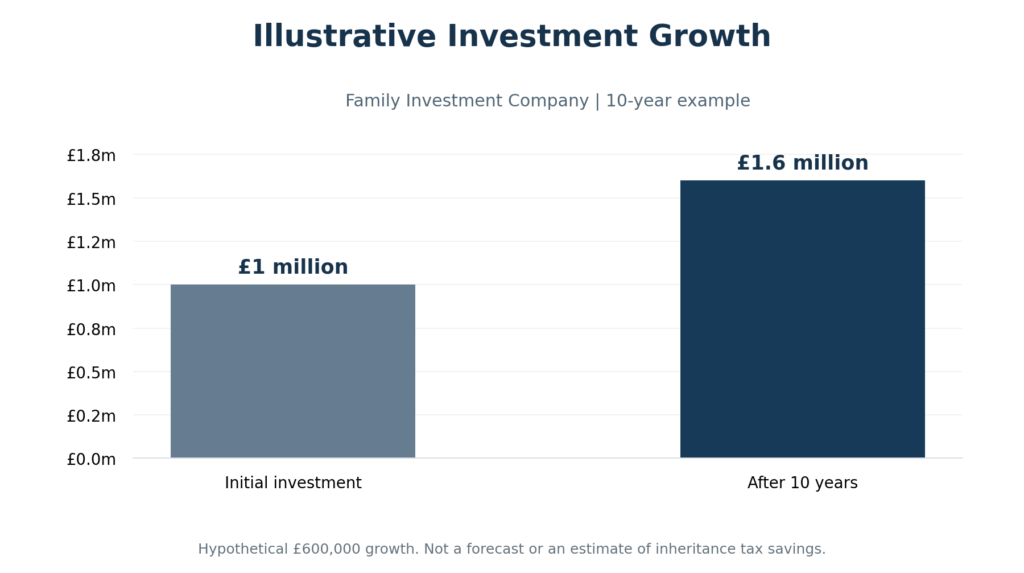
Illustrative investment growth from £1 million to £1.6 million over ten years, representing a £600,000 increase in value. Actual investment returns and tax outcomes will vary. This example does not represent guaranteed returns or Inheritance Tax savings.
However, the tax position depends on the original funding, actual share values, retained rights and the structure of the transaction.
For example, a shareholder loan of £1 million owed to the parents would ordinarily remain an asset in their estates unless they subsequently transfer or release it in a way that has been properly considered for tax purposes.
What Happens to the Newborn’s Dividends?
Suppose the company declares dividends on shares beneficially owned by the newborn.
If a parent provided the shares under an arrangement caught by the parental settlements legislation and the relevant income exceeds £100, the dividends will generally become taxable on that parent.
However, the company may retain profits rather than declare dividends.
If the child’s shares genuinely participate in future growth, the child may still benefit from capital appreciation, although further tax and valuation issues can arise.
This illustrates the distinction between transferring future investment growth and transferring current taxable income.
Using Different Share Classes for Family Members
Families frequently use different share classes to separate management rights from economic ownership.
A Shares: Voting Rights
Parents may hold A shares that provide voting control.
These shares can help them appoint directors and influence key company decisions.
However, retaining voting control must not compromise the intended transfer of economic value.
B Shares: Dividend Rights
The company may issue B shares carrying specified rights to dividends.
For instance, adult children could hold shares that allow them to receive distributions when the directors lawfully declare dividends.
However, arrangements designed to divert income from higher-rate taxpayers to family members may attract scrutiny under the settlements legislation.
C Shares: Future Capital Growth
The company may create another share class that participates in future growth above a specified value.
This may help families distinguish between wealth already accumulated by parents and future value that they want to pass to their children.
Nevertheless, growth shares require careful drafting and valuation.
A company cannot guarantee an Inheritance Tax benefit merely by labelling shares as growth shares.
The legal and economic rights must support the intended tax treatment.
Family Investment Companies and Property Investments
Families with substantial property portfolios sometimes consider an FIC.
A company can acquire and hold investment properties, receive rental income and reinvest after-tax profits.
However, transferring existing properties from personal ownership into a company may create significant tax liabilities.
Stamp Duty Land Tax
A company acquiring residential property from connected individuals may face Stamp Duty Land Tax calculated using market value rules.
Higher SDLT rates may also apply to residential property purchases by companies.
Therefore, families should calculate SDLT before transferring properties.
See HMRC: Stamp Duty Land Tax.
Capital Gains Tax
Transferring personally owned property to a connected company can create a Capital Gains Tax disposal at market value.
Families may therefore face Capital Gains Tax even if the company does not pay the owners the full market value in cash.
Reliefs may apply to some qualifying transactions, but landlords should never assume that incorporating a property portfolio is tax-free.
Our Property Accountants and Tax Advisers can help assess the tax consequences of property ownership structures.
Should Families Purchase New Properties Through an FIC?
In some circumstances, acquiring future investments directly through a company may be more practical than transferring existing properties.
However, the decision depends on financing, rental profitability, the shareholders’ personal tax positions and the intended use of investment income.
Families should consider the overall costs before proceeding.
Family Investment Company or Family Trust?
Family Investment Companies and trusts can both support long-term succession planning.
However, they have different legal and tax characteristics.
A trust allows trustees to manage assets for beneficiaries according to a trust deed.
An FIC allows directors to manage assets owned by a company, while shareholders hold defined ownership rights.
Trusts may provide considerable flexibility over beneficiaries and distributions.
FICs may appeal to families who prefer a corporate structure with defined share ownership and familiar company governance arrangements.
Nevertheless, some trusts face Inheritance Tax charges when assets enter the trust, during ten-year anniversaries and when assets leave.
Families should also examine whether a trust holding FIC shares would provide appropriate control and succession benefits.
Neither arrangement automatically offers the lowest tax liability.
What Are the Disadvantages of a Family Investment Company?
An FIC can introduce costs and complications that do not exist when family members hold investments personally.
First, establishing the company may require specialist tax advice, legal documentation and share valuations.
Second, the company must maintain accurate accounting records, prepare annual accounts and comply with Companies House requirements.
Third, the company may pay Corporation Tax on its taxable profits, followed by personal tax when shareholders extract dividends.
Fourth, different shareholder rights may create family disputes, especially where children have different financial needs.
Finally, an FIC can limit access to capital because shareholders cannot withdraw company funds as though they were personal savings.
Families should assess these factors against the potential long-term advantages.
How to Set Up a Family Investment Company
Establishing an FIC requires several important decisions.
-
Review the family’s assets. Identify investments, savings, existing properties and future financial needs.
-
Identify the intended beneficiaries. Decide whether the company will benefit adult children, minors, newborns or future grandchildren.
-
Review tax implications. Assess Corporation Tax, Capital Gains Tax, Income Tax, Inheritance Tax and potential SDLT.
-
Design the share structure. Decide how voting rights, dividend rights and capital growth will operate.
-
Prepare legal documentation. Arrange suitable articles of association, shareholder agreements and trust documents where necessary.
-
Incorporate the company. Register the company and comply with Companies House requirements.
-
Introduce funds and investments. Properly document loans, share subscriptions and asset transfers.
-
Maintain compliance. Prepare accounts, tax returns, dividend records and statutory company documents.
-
Review the structure regularly. Reassess the arrangements when children reach adulthood or family circumstances change.
For company accounting and compliance support, visit Adam Accountancy Accounting and Tax Services.
Frequently Asked Questions About Family Investment Companies
Can a newborn baby be a shareholder in an FIC?
Yes. A newborn may beneficially own shares. However, families should consider an appropriate legal holding arrangement and ensure the company’s articles permit it.
What is the minimum age for owning company shares?
There is no general statutory minimum age in England and Wales.
Can a 12-year-old receive dividends?
Yes. However, if a parent provided the shares and the parental settlements rules apply, relevant income above £100 per tax year may become taxable on the parent.
What is the minimum age for becoming a company director?
The general minimum age is 16 under section 157 of the Companies Act 2006.
Are dividends taxable on the child or the parent?
The answer depends on the child’s age, the source of the shares and the settlements legislation.
A child under 18 may have dividends attributed to a parent. Once the child reaches 18, income from genuinely owned shares will normally be taxable on the child, subject to other relevant rules.
Can grandparents give FIC shares to newborn grandchildren?
Yes. Genuine gifts from grandparents generally fall outside the specific parental £100 settlements rule. However, other tax and legal rules may still apply.
Do children need to receive dividends every year?
No. The company may retain profits, provided it follows applicable company law and the share rights.
Does an FIC eliminate Inheritance Tax?
No. However, genuine transfers of value and future growth may support Inheritance Tax planning where the family structures the arrangements appropriately.
Can children sell their shares?
This depends on the company’s articles, shareholder agreements, the child’s age and the relevant legal arrangements. Families commonly include restrictions on transfers to protect long-term ownership.
Is an FIC suitable for every family?
No. The costs, administrative requirements and potential double taxation may outweigh the advantages, particularly for smaller portfolios.
How Adam Accountancy Can Help With Family Investment Companies
Establishing a Family Investment Company requires careful tax planning, particularly when parents want to transfer wealth to children or grandchildren while retaining control over family investments.
At Adam Accountancy Limited, we help individuals and families understand the tax implications of Family Investment Companies and develop suitable long-term investment and succession planning strategies.
Our services include:
- Reviewing proposed Family Investment Company structures and their tax implications.
- Advising on Capital Gains Tax and Corporation Tax considerations.
- Assessing the tax treatment of dividends paid to family members, including children under 18.
- Reviewing the tax implications of transferring investments and property into a company.
- Preparing annual company accounts and Corporation Tax returns.
- Supporting ongoing accounting and tax compliance.
Where arrangements require specialist Inheritance Tax planning, legal documentation or complex share valuations, we can work alongside appropriately qualified professionals.
Explore Our Related Tax Services
- Capital Gains Tax Advice
- Property Accounting and Tax Planning
- Limited Company Accounting and Tax Services
- Property Tax Questions for UK Landlords
Need Advice on Setting Up a Family Investment Company?
Whether you are considering transferring wealth to your children, establishing an investment company or planning your family’s financial future, our team can help you understand the available options and associated tax implications.
Book a Family Investment Company Tax Consultation or call 01753 373 505 to discuss your requirements.
Conclusion
Family Investment Companies offer a flexible way for families to manage investments and plan the transfer of wealth to future generations.
One of their important features is that children can participate from birth, potentially benefiting from long-term investment growth.
However, parents must distinguish between transferring capital growth and paying dividend income to children.
For children under 18, the parental settlements legislation may attribute dividends to a parent where the relevant income exceeds £100 per tax year.
Once children reach adulthood, their own tax positions generally become more relevant.
Therefore, families should consider age, ownership rights, funding arrangements, inheritance planning and overall tax efficiency before establishing an FIC.
With appropriate professional advice, a Family Investment Company can form part of a carefully structured, long-term family wealth strategy.
Tax information reviewed for the 2026/27 UK tax year. This article provides general information, not individual tax or legal advice.
Need Help With Your Self Assessment Tax Return?
For straightforward online Self Assessment tax return services, visit eTaxFiling, our dedicated online tax filing service.
Looking for professional accounting or tax advice? At Adam Accountancy, our experienced accountants in Slough provide reliable support to individuals, contractors and businesses across the UK.
Call us on 01753 373 505 for a free, no-obligation initial consultation, or contact us using our online form, and our team will be happy to assist you.